For many eye health professionals, the barriers to further training are practical rather than motivational. Time away from clinic, course fees and restrictive entry requirements can all limit access. This can be particularly true for colleagues working in under-resourced settings in the areas of greatest need.
Current estimates suggest there are 1.1 billion people living with untreated vision impairment worldwide, and more than 90% of this sight loss is treatable or preventable [1,2]. This unaddressed impairment is overwhelmingly concentrated in low- and middle-income countries (LMICs).
Improving eye health has been shown to improve productivity and quality of life and can likely reduce comorbidities and even mortality. A growing body of research has demonstrated that eye health is a major public health and economic priority, and that its integration into health systems will have wide-reaching implications for general health.
To meet this public health challenge, funding and resources must be unlocked to ensure everyone can achieve good eye health. However, without appropriate workforce training, it will be impossible to tackle existing cases or address emerging conditions.
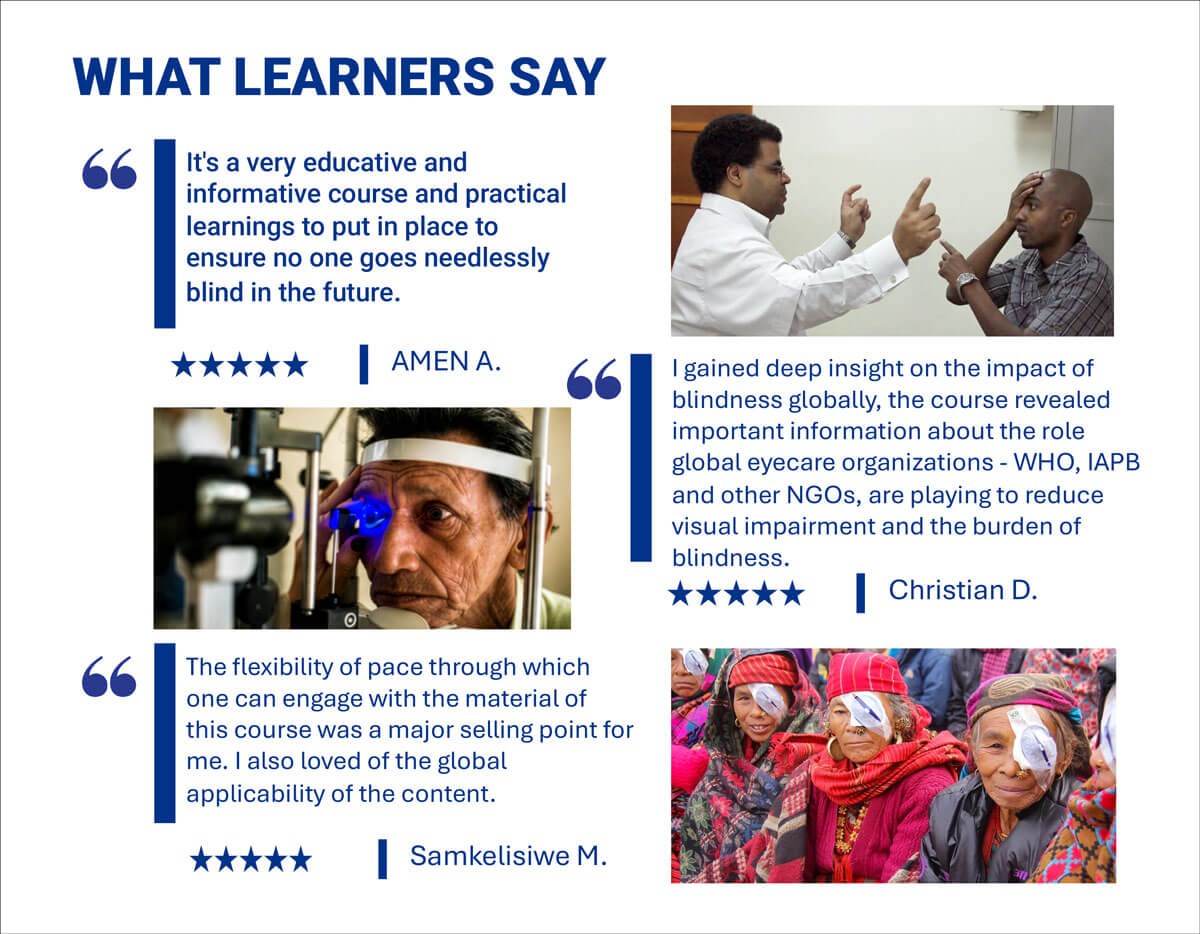
"It is an excellent course for both doctors and professionals involved in eyecare services. It gives you practical ideas how to proceed, plan, evaluate your projects and achieve your aims. I will recommend this course to all eye doctors"
– Muhammad N
The International Centre for Eye Health (ICEH), based at the London School of Hygiene & Tropical Medicine (LSHTM), has long recognised this training gap among eye health professionals in the places where it works. For many working on the frontline, access to high-quality, up-to-date learning resources can be very limited and further constrained by rigid application criteria, the mode of delivery and relatively high costs. Courses are often inaccessible or simply don’t exist and planning, treatment and outcomes were suffering as a result. Moreover, ongoing eye health training has primarily catered to ophthalmologists, overlooking the development needs of other allied health providers. Improving equity of access and participation in high-quality training is crucial to strengthening the whole health workforce at the local level, especially in remote settings.
One of the ways in which the ICEH addressed this gap was to establish the Open Education for Eye Health (OEEH) programme, which began in 2014, to collaboratively develop and deliver a series of open online courses. The ICEH Open Education (OE) team recognised that, in the digital age, there was an opportunity to reach eye health professionals with the knowledge and skills they needed to ensure care was the best it could be. Starting with a single course, the portfolio now includes eight courses across eye health disciplines. Since their inception, more than 44,000 students have enrolled from 180 countries and territories.
The first ICEH online open education course
The first open online course was ‘Global Blindness: Planning and Managing Eye Care Services’. Its creation was based on a collaborative approach, ensuring applicability within a local context while remaining aligned with the global agenda for the elimination of avoidable blindness. Seeing is Believing (SiB), a global initiative between Standard Chartered Bank and the International Agency for the Prevention of Blindness (IAPB), generously funded this project, supporting innovative approaches in eye health education.
Expansion and growth
Building on the success of that first course, the ICEH OE team has gone on to develop a further seven open online courses and the portfolio continues to grow.
‘Global Blindness: Planning and Managing Eye Care Services’ was followed by two courses, funded by the Queen Elizabeth Diamond Jubilee Trust, covering fundamental principles of epidemiology as applied to eye disease, ahead of four disease-specific courses.
‘Eliminating Trachoma’ was created in 2016 in partnership with more than 37 collaborators from 12 countries, with funding from Sight Savers and the Queen Elizabeth Diamond Jubilee Trust, and support and validation by the (NTD) technical officer at the World Health Organization (WHO). The course targeted teams from trachoma-endemic countries and attracted a diverse range of professional cadres and disciplines, including clinicians providing surgical services, programme managers, field workers administrating antibiotics and teams implementing water and sanitation improvements. Its focus was to improve access to training, equipping and mobilising health workers, as part of the wider GET 2020 trachoma elimination initiative. The course has coincided with the increasing elimination of trachoma as a public health concern in countries globally.
"Throughout the course I found myself reflecting a lot on the existing way of work and each and every topic is insightful. It has actually increased my interest in eye health issues in India manifold! "
– Tushita M
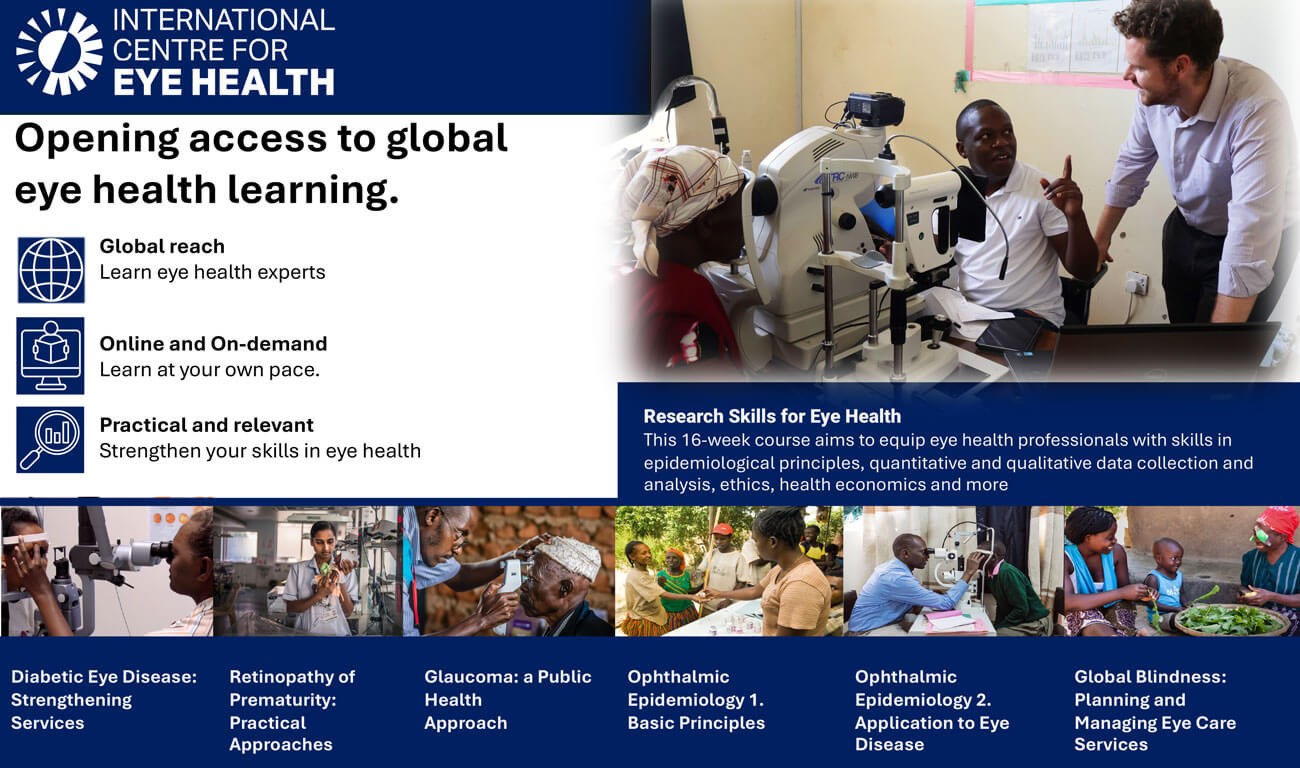
Additional courses have followed, aimed at strengthening the skills of the eye health and allied health workforce focusing on diabetic eye disease, retinopathy of prematurity and glaucoma. Participant feedback has repeatedly highlighted the value of these learning opportunities.
A ‘value-creation framework’ approach is applied to evaluate the impact of participant’s learning journeys. This enables the ICEH OE team to capture unique insight into the value of the course to individuals and the communities with whom they engage, going beyond completion and engagement metrics [2].
Research skills in eye health
Our most recent course, ‘Research Skills for Eye Health’, equips eyecare professionals and those working in affiliated disciplines with the knowledge and skills needed to interpret and apply evidence in planning and delivering eyecare services. It aims to build research capacity and strengthen evidence-based eye health systems, emphasising interdisciplinary working, self-reflection, critical appraisal and the synthesis of rigorous, ethical and effective research. In so doing it fosters a local, national and international network of health professionals working to improve vision and prevent blindness worldwide.
This 16-week course covers global challenges in ophthalmology, essential epidemiology and statistics for eyecare, methods and skills for effective research, and how to plan and implement eyecare services to bring about change.
ICEH open access approach
Our open-access approach focuses on improving equity of access to, and participation in, high-quality training, which is critical for strengthening health workers’ competencies and practice at the local level. It is not simply about providing information and reaching large numbers of people; the approach has always been, and remains, about providing contextually relevant, high-quality training in a sustainable and inclusive way.
The OEEH courses are delivered at no cost to the practitioner, through LSHTM’s Open Study platform. Through our collaborations with a wide range of local and global experts, course content continues to evolve to meet the needs of practitioners.
All educational content created as part of our ICEH OE programme is freely available and can be downloaded, reused, adapted and redistributed under Creative Commons licenses. This extends the learning opportunity beyond the individual health worker to team learning and increases learning opportunities for allied health workers. Downloadable infographics, presentations and articles are provided so that they can be used, reused and adapted for local settings and training.
The future
The ICEH OE team has become an important node, connecting experts with a broad network of participants. The team was awarded the prestigious Collaborative Award for Teaching Excellence (CATE 2019) by the UK Higher Education Academy. The OEEH project has moved across a continuum – from innovation to informative, formative to transformative – and continues to advance equity in eye health education.
We are incredibly grateful for all the support ICEH has received to date, which has enabled us to continue to provide up-to-date, high-quality education, free-of-charge, and to directly improve global eyecare. For the programme to keep meeting the needs of global eye health workers, its content must continue to evolve and be regularly updated.
Building on the success of our current courses, our next priority is to develop two new online courses focused on primary eyecare and refractive error. This is timely and relevant and aligns with the mandate of the 2030 In Sight initiative and WHO’s target to increase effective refractive error coverage by 40% by 2030.
Optometrists are also among the target audience for these courses. As essential members of the eye health team, they are often the first eye health provider that a patient encounters, across a diverse range of eye conditions. Optometrists play a key role in refractive error correction and often initiate the care pathway for several diseases, including glaucoma and other underlying co-morbidities. Public health training is not typically offered in core optometry or ophthalmic clinical training curricula. By applying public health training, healthcare personnel can estimate the magnitude of need and develop appropriate, sustainable eyecare services specific to the health system in their setting.
Education for all
The ICEH OEEH programme demonstrates the benefit that open online education can provide, particularly in low-resource settings, where access to knowledge is key to uplifting communities and mitigating preventable disease. Evidence from the initiative’s impact assessment suggests that high-quality, open online courses can have a significant impact on professional development for health practitioners, educators and managers. Reflecting on their impact, the OEEH team stresses the importance of a clear, long-term vision, together with effective leadership to ensure that ‘Open’ education continues to gain the traction it deserves.
To explore the range of courses ICEH offers please visit our website for more information: https://iceh.lshtm.ac.uk/oer-courses/
References
1. Burton M, Ramke J, Marques A, et al. The Lancet Global Health Commission on Global Eye Health: vision beyond 2020. Lancet Glob Health 2021;9(4):e489–e551.
2. https://www.iapb.org/blog/explainer-making
-sense-of-new-global-eye-health-data/
[Link last accessed August 2026]
3. Patel D, Leck A, McCormick I, et al. Value Creation Framework to Assess MOOC-based Learning. Pan-Commonwealth Forum 9 (PCF9). 9–12 September 2019; Edinburgh, UK.
Declaration of competing interests: None declared.