As medical education evolves, the importance of ‘near-peer teaching’ – where trainees teach those just below them in terms of medical years – has gained recognition across specialties. In ophthalmology, a field known for its steep learning curve, niche skills and fast-paced clinics, clinical fellows are uniquely positioned to play a vital role in the education of medical students, foundation doctors and even early-stage registrars.
Having recently undertaken a clinical teaching fellow role with a particular interest in ophthalmology, I’ve come to appreciate not only the value clinical fellows add to service delivery, but also their often-underestimated importance as teachers and mentors.
Why near-peer teaching matters in ophthalmology
The term ‘near-peer’ typically refers to someone up to four levels above the learner – someone who has recently been through the same educational experiences [1]. The proximity in knowledge, combined with a shared language and empathy for the learner’s struggles, makes near-peer teaching particularly effective.

This model excels within the ophthalmology service at the hospital I work in. Clinical exposure during undergraduate training is limited, often confined to brief rotations or optional modules, and as a result, many students and foundation doctors enter ophthalmic rotations feeling underprepared and overwhelmed. This is where clinical teaching fellows come in.
Studies have shown that near-peer teaching improves learners’ confidence and academic performance, while fostering a more approachable learning environment [1]. For medical students and junior doctors, fellows often serve as that critical bridge between unfamiliar concepts and real-world clinical application.
The unique position of clinical fellows
Clinical fellows often sit in a ‘goldilocks zone’ within the clinical hierarchy, where they are:
- More senior than foundation doctors and students, with enough experience to confidently teach clinical skills
- Not yet fully immersed in higher surgical training, giving them more flexibility in their schedule, and
- Actively involved in day-to-day service, which keeps their teaching grounded in real-world practice.
Unlike consultants or senior registrars – who may be too busy or too far removed from basic teaching – fellows are accessible, present and often more relatable. This closeness builds trust and encourages learners to ask questions they may not feel comfortable raising with senior staff.
What clinical fellows can teach
The clinical fellow is perfectly placed to deliver hands-on, structured teaching sessions in areas that are often neglected in formal education:
- Slit lamp technique and examination
- Direct and indirect ophthalmoscopy
- Basic principles of refraction and visual acuity testing
- Ocular pharmacology and common medications
- Consent and communication in ophthalmology
- Getting the most out of working in ophthalmology placements or tasters
- Debriefing sessions at the end of placements.
This is not an exhaustive list, and these are practical, examinable and often service-critical skills – yet many students and junior doctors can finish their rotations with little to no prior experience in them. Importantly, effective teaching in ophthalmology does not sit solely with doctors. Engaging the expertise of the wider multidisciplinary team is vital; advanced practitioners are ideally placed to teach procedural skills such as intravitreal injections, while optometrists are best positioned to support learning around refraction, visual assessment and optical principles. When clinical teaching fellows work alongside these professional groups, a cross-professional near-peer model emerges – one that enriches learning, reflects real-world practice and better prepares trainees for multidisciplinary ophthalmic care.
By offering dedicated sessions or simply taking the time to teach on the go, clinical teaching fellows can demystify the specialty and empower learners to participate meaningfully in clinics.
Near-peer teaching in action: my experience
During my time as a foundation doctor and now a clinical teaching fellow, I made a conscious effort to support junior doctors and medical students, particularly those on short rotations with limited ophthalmology exposure. This often started informally, offering tips on how to get more hands-on experience or answering questions in clinic or eye casualty, and gradually evolved into more structured sessions, including tutorials, fundoscopy and slit lamp workshops, OSCE preparation and more.
What I found was that learners were incredibly receptive. They valued the opportunity to ask ‘silly’ questions, observe clinical reasoning in real time and practise under supervision – all without the pressure of formal assessment. One student memorably described their anxiety about “looking foolish in front of a black lanyard,” using this as shorthand for the perceived seniority of consultants, and how learning from someone closer in training level helped reduce this barrier. While this is not a criticism of consultants, whose teaching is invaluable, it helps explain why near-peer teaching can be so effective. By reducing perceived hierarchy, clinical fellows can create psychologically safe learning environments that encourage questions, normalise uncertainty and support confident engagement with learning.
Many students and junior doctors told me it was the first time they’d been properly shown how to use a slit lamp, or that they had finally understood the rationale behind using dilating drops or how to actually instil the drops. These were not trivial gaps; they were fundamental skills that often go unaddressed in busy clinical settings. It highlighted the critical role clinical fellows can play in building confidence, consolidating foundational knowledge and sparking interest in ophthalmology.
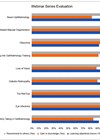
The positive impact was reflected in formal feedback: 93% of the 56 respondents (medical students and junior doctors) reported greater comfort and engagement in sessions led by teachers up to four years senior, compared with those led by consultants or senior registrars. Many specifically mentioned feeling more at ease asking questions or admitting when they didn’t understand something and wanting something covered again – a dynamic that near-peer teaching naturally fosters.
The mutual benefit: fellows learn too
Near-peer teaching doesn’t just benefit the learners – it helps fellows, too. Teaching reinforces our own understanding, improves communication skills and encourages reflection.
When you have to explain the pathophysiology of angle-closure glaucoma in plain terms, or walk someone through fluorescein staining, you’re forced to clarify your own thinking. You identify your own knowledge gaps, refine your explanations and develop the skills needed for future supervision, assessment and even teaching qualifications.
These experiences help fellows become more effective mentors and educators. They foster supportive professional relationships, encourage reflective practice and build confidence in guiding others – capabilities increasingly valued within structured training programmes and providing a solid foundation for future educational and supervisory roles [2,3].
Embedding fellows into undergraduate and postgraduate teaching
There’s growing recognition that fellows should be formally included in educational strategy:
- Involvement in medical school speciality teaching, e.g. as facilitators or demonstrators in clinical skills sessions
- Opportunities to lead foundation doctor inductions or deliver teaching during regional study days
- Support to complete teaching qualifications such as PG certificates in medical education
- Time allocated for teaching within job plans, especially in fellowship posts with research or education remits.
This not only improves teaching delivery but also elevates the profile of fellows as educators – something that benefits students, juniors, departments and ultimately patients.
Conclusion
Ophthalmology is a specialty that relies heavily on practical skills, clinical judgement and visual recognition. It’s also one that many trainees feel intimidated by at first. Clinical fellows, by virtue of their experience and accessibility, are ideally placed to bridge this gap through near-peer teaching.
By embracing this role, whether through formal sessions or informal mentorship, fellows can make a lasting impact on learners, improve departmental education culture and develop as future educators themselves.
In a time when service pressures are high and education risks being sidelined, the clinical teaching fellow can be a quiet but powerful force for progress in ophthalmology training. By reflecting on our own mentorship styles and actively supporting colleagues’ learning, all clinicians, from students to consultants, can contribute to a culture of shared learning that strengthens both education and patient care.
References
1. Ten Cate O, Durning S. Dimensions and psychology of peer teaching in medical education. Med Teach 2020;42(2):124–30.
2. Nelson AJ, Nelson SV, Linn AM, et al. Tomorrow’s educators… today? Implementing near-peer teaching for medical students. Med Teach 2013;35(2):156–9.
3. Rees EL, Quinn PJ, Davies B. Fotheringham V. How does peer teaching compare to faculty teaching? A systematic review and meta-analysis. Med Teach 2016;38(8):829–37.
Declaration of competing interests: None declared.