
A 48-year-old woman was referred from the diabetic retinopathy screening programme to the eye casualty service following the incidental finding of bilateral optic disc swelling. Mild background diabetic retinopathy was present, and she was otherwise initially asymptomatic.
Due to concern regarding a possible neuro-ophthalmic or retinal vascular cause, the case was discussed with the on-call ophthalmology doctor. The patient was advised to attend eye casualty the same day for urgent assessment; however, she was unable to attend immediately and presented the following morning.
Past medical history
The patient had a history of hypertension and type 2 diabetes mellitus. She was receiving multiple antihypertensive agents including losartan, nifedipine and spironolactone, consistent with resistant hypertension. She was also on dapagliflozin and semaglutide for diabetes management.
On examination in eye casualty, her blood pressure was severely elevated at 257/140mmHg. Further history revealed a two-week history of intermittent headaches, which had not initially been disclosed during retinal screening.
Clinical examination
Visual acuity (unaided) was 6/6+2 in the right eye (RE) and 6/4.8−1 in the left eye (LE). Intraocular pressure (iCare tonometry) was 22mmHg RE and 21mmHg LE. Pupils: No relative afferent pupillary defect detected in either eye.
Clinical interpretation
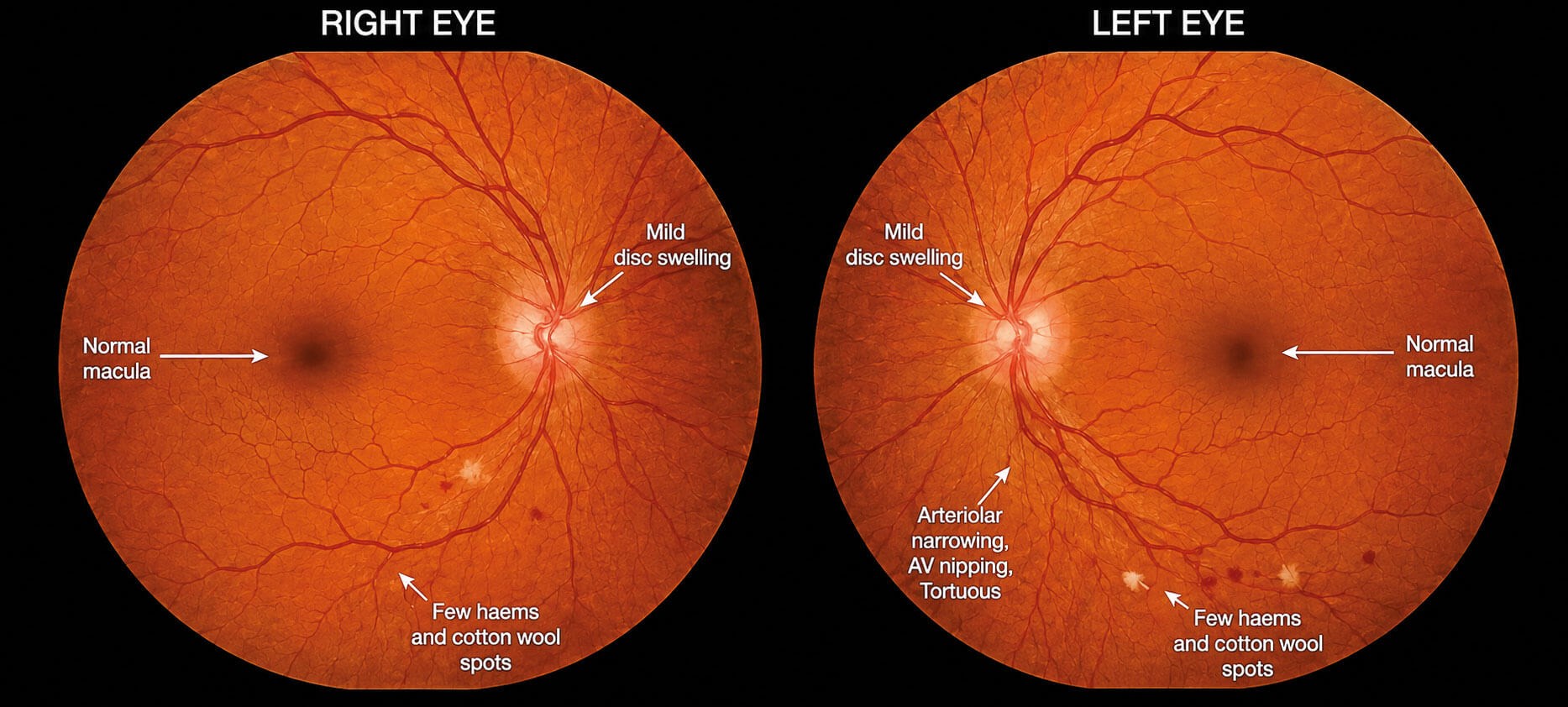
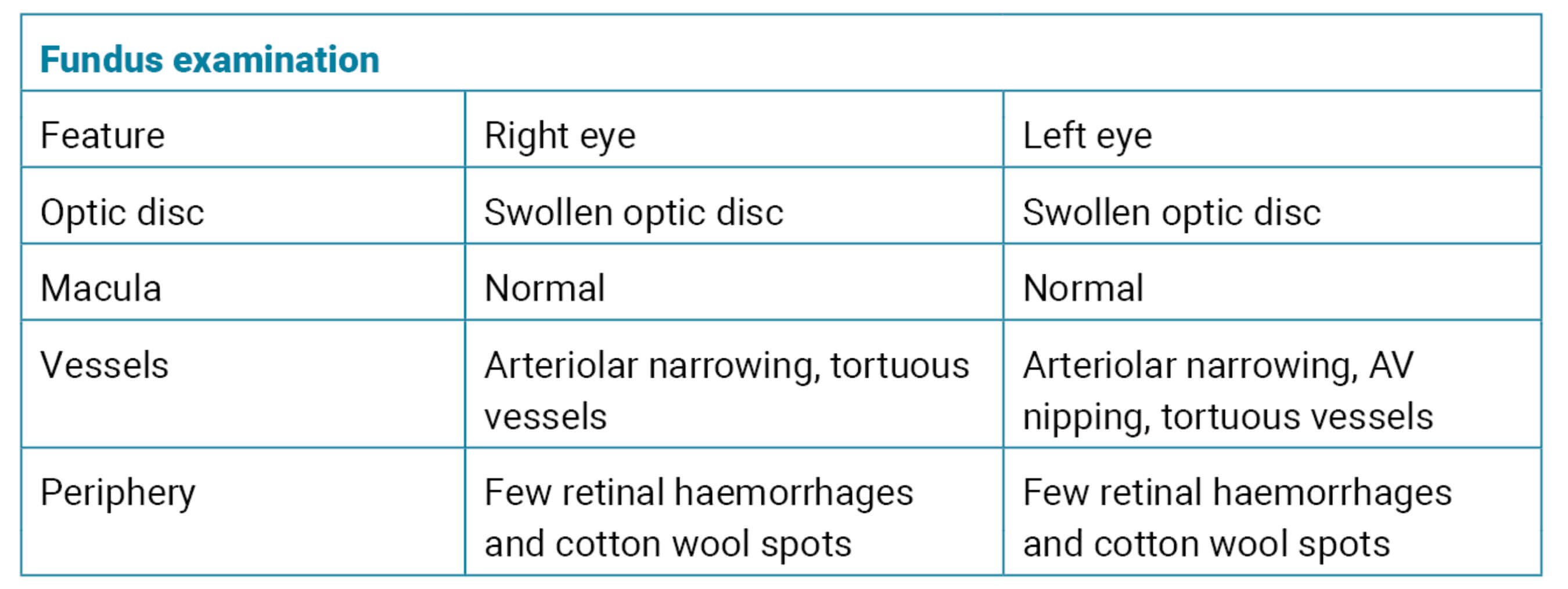
Fundoscopic examination (Figure 1) demonstrated bilateral optic disc swelling associated with arteriolar narrowing, vascular tortuosity, arteriovenous nicking, retinal haemorrhages and cotton wool spots. These findings are consistent with hypertensive retinopathy with optic nerve head involvement and indicate significant hypertensive end-organ damage.
The patient was urgently referred to the emergency department for blood pressure management and was subsequently admitted for treatment of hypertensive emergency.
Discussion
This case highlights malignant hypertension presenting incidentally during diabetic retinal screening. Malignant hypertension is a medical emergency and a recognised cause of optic disc swelling, requiring urgent systemic assessment and treatment to prevent irreversible end-organ damage.
The optic disc swelling observed in this case was most consistent with hypertensive optic disc oedema secondary to impaired axoplasmic flow and breakdown of the blood-retinal barrier in the setting of severely elevated blood pressure. The associated cotton wool spots, retinal haemorrhages, arteriolar narrowing and vascular tortuosity further supported the diagnosis of severe hypertensive retinopathy.
Despite critically elevated blood pressure, the patient was only minimally symptomatic, illustrating how life-threatening systemic disease may initially present with subtle ophthalmic findings alone.
This case reinforces the importance of routine blood pressure measurement in all patients presenting with optic disc swelling, alongside careful systemic history-taking, particularly regarding headache and neurological symptoms. It also highlights the importance of maintaining flexible triage pathways when additional clinical information emerges during assessment.
Conclusion
Diabetic retinal screening can reveal significant systemic disease in addition to ocular pathology. Optic disc swelling should be regarded as a medical red flag requiring urgent systemic assessment, particularly blood pressure measurement, to prevent serious morbidity and mortality associated with malignant hypertension.
TAKE HOME MESSAGES
-
Any presentation of headache, regardless of duration, in either emergency or ophthalmic settings should prompt measurement of blood pressure, and intraocular pressure where possible, prior to discharge.
-
Optic disc swelling requires urgent exclusion of systemic causes, including malignant hypertension.
-
Blood pressure measurement is essential in all cases of optic nerve head swelling.
-
Hypertensive retinopathy may present with minimal systemic symptoms despite severe disease.
-
Targeted history-taking can reveal clinically significant symptoms not initially volunteered.
-
Flexible triage pathways and multidisciplinary communication are essential for safe management.
References
1. Bisognano JD. Malignant hypertension guidelines. Medscape 2024 [online]:
emedicine.medscape.com/article/
241640-guidelines
2. Mehta S. Hypertensive retinopathy. MSD Manual Professional Edition 2024 [online]:
www.msdmanuals.com/professional/
eye-disorders/retinal-disorders/hypertensive-retinopathy
3. Tripathy K, Arsiwalla, T. Hypertensive retinopathy. StatPearls. Florida, USA; StatPearls Publishing; 2026.
[All links last accessed August 2026]





