Last issue we discussed Monet and Cassatt’s experience of painting through cataract. We now move to two stories of resilience in the face of macular degeneration, Edgar Degas and Georgia O’Keeffe.
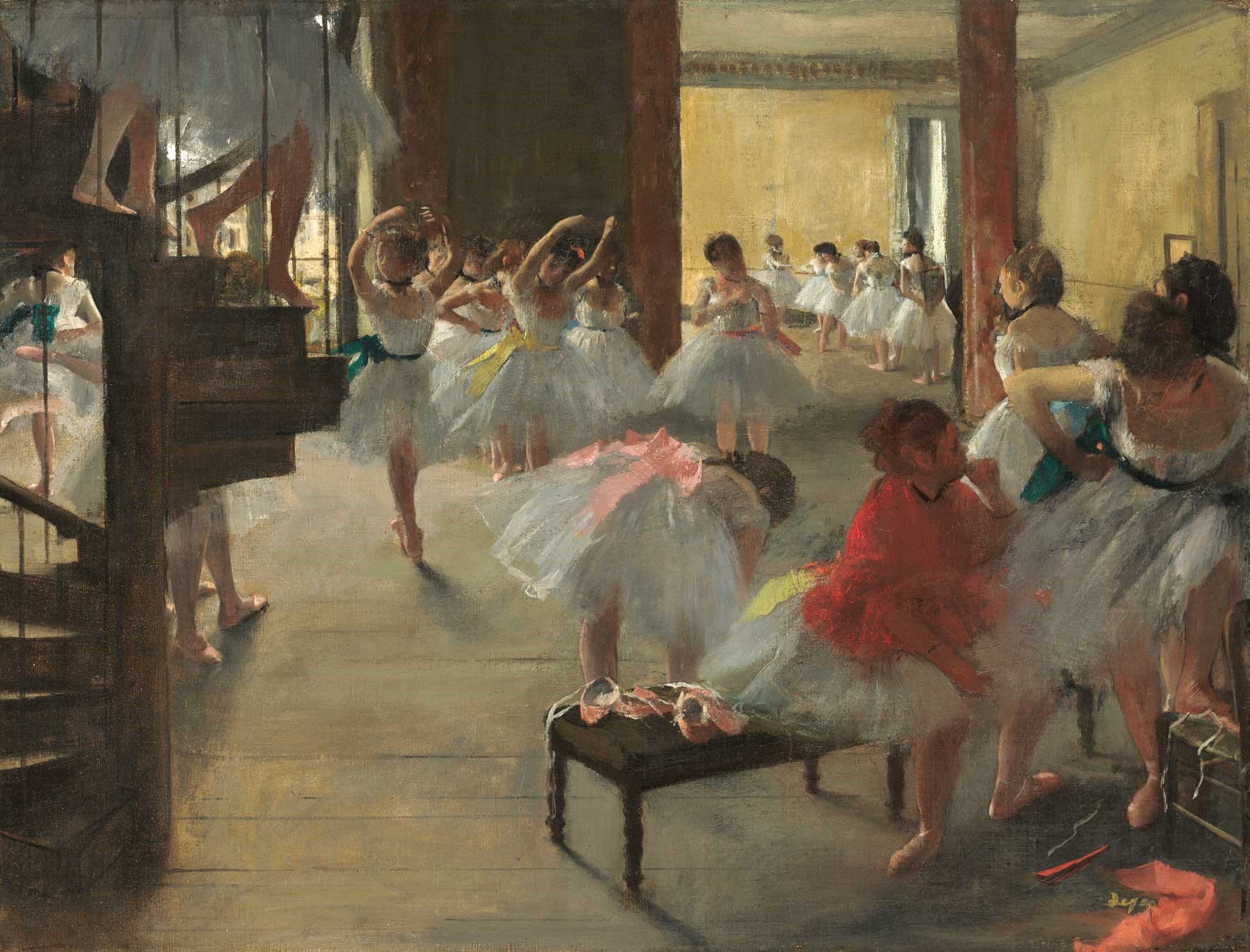
Edgar Degas. (c1873) ‘The Dance Class’, oil on canvas. Courtesy of the National Gallery of Art (Public Domain Image).
Edgar Degas (1834–1917), retinal degeneration
One of the most fascinating and adaptive artists challenged by visual impairment is Edgar Degas. Born in 1834, Degas was a French painter frequently categorised as an impressionist, although his experimental styles leant themselves to various movements throughout his life, perhaps driven by his deteriorating eyesight.
From the age of 36, Degas complained of blurred vision and photosensitivity, which progressively worsened throughout his life [1]. His maternal first cousin was similarly afflicted. Although there is no definitive diagnosis, research suggests that given the pattern of vision loss and likely hereditary component, Degas symptoms could be due to an ABCA4-associated retinal degeneration [2].
Prior to his visual impairment, Degas’ works included intricate portraiture approaching realism, bright depictions of horse races and delicate ballerinas in soft tones. As his condition worsened, Degas’ sensitivity to light limited his ability to work outdoors. He preferred his dimly lit studio, insisting the large windows remain dirty and partially covered [1]. Although he spent much of his life in fear of blindness, he is an impressive example of someone who adapted in the face of adversity.
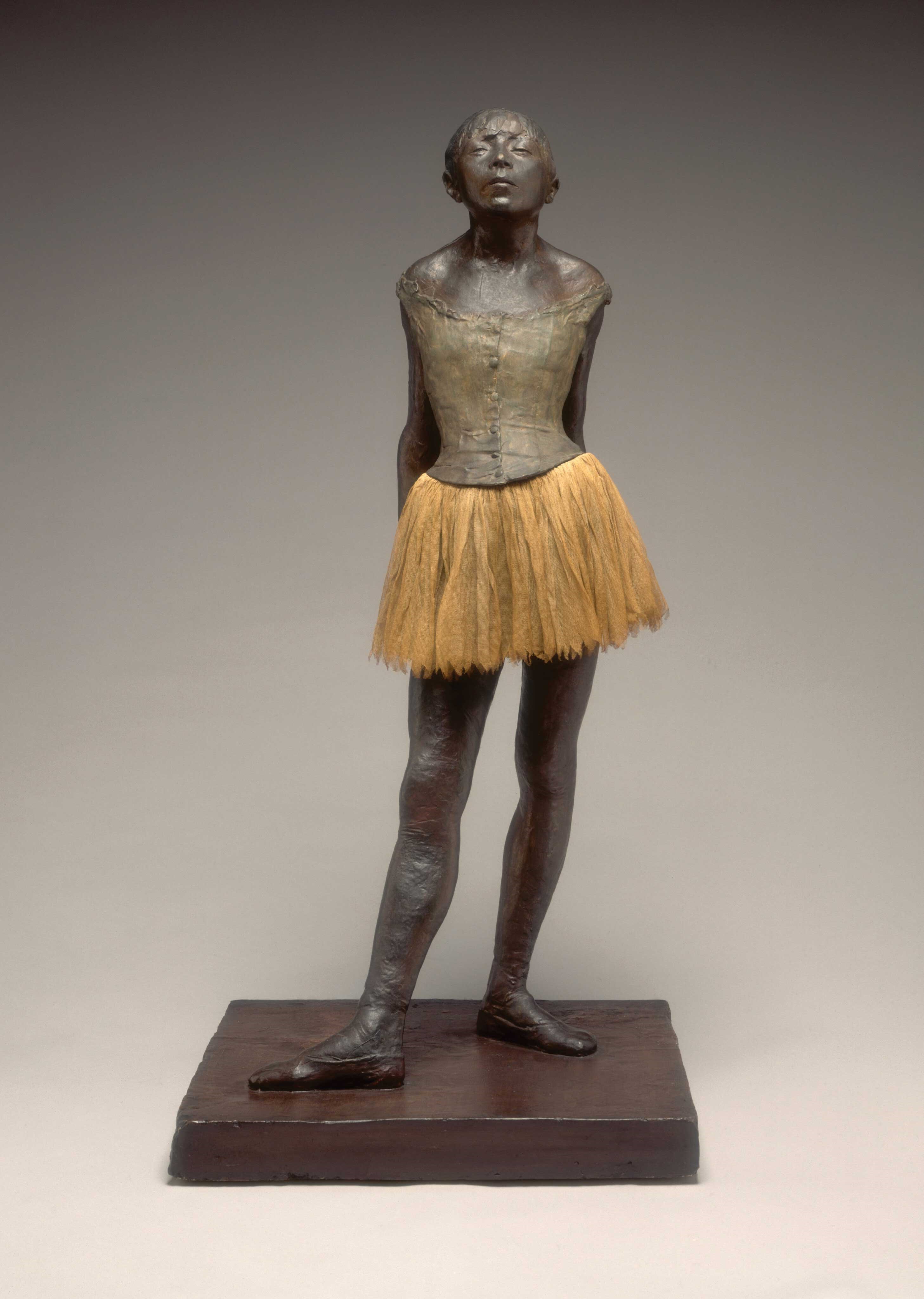
Edgar Degas. (Original wax c1878, cast c1920) ‘Little Dancer Aged Fourteen’, painted plaster, fabric, metal armature on plaster base. Courtesy of the National Gallery of Art (Public Domain Image).
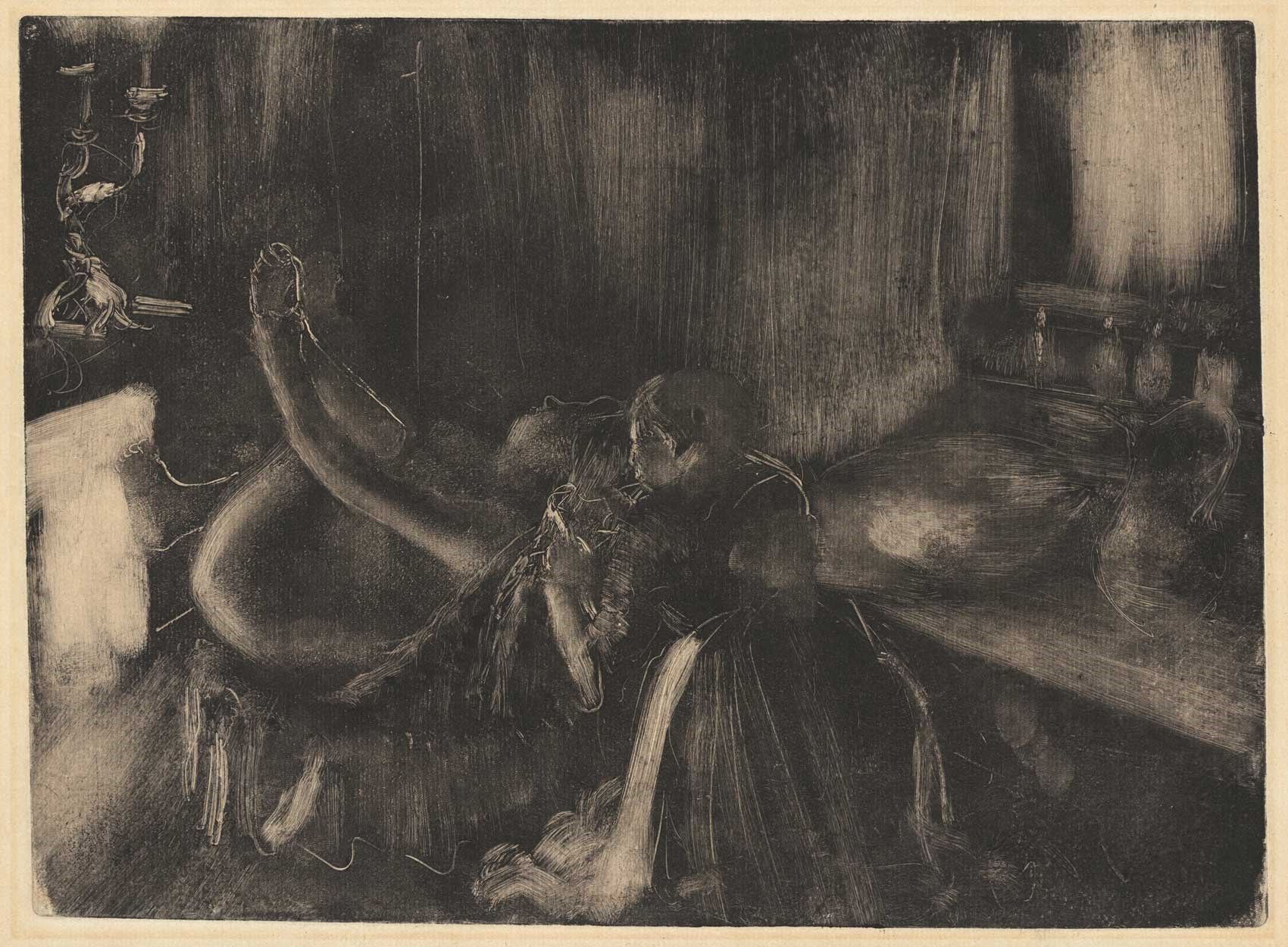
Edgar Degas. (c1880/1890) ‘Woman by a Fireplace’. Monotype on heavy laid paper. Courtesy of the National Gallery of Art (Public Domain Image).
As with Monet and Cassatt, Degas moved from using challenging oil paints to more forgiving pastels. However, he did not settle there. He had his turn at sculpture, switching to modelling ballerinas and horses with this tactile craft more suited to visual impairment. Then he experimented with monotypes – a method of printmaking by drawing ink on a metal plate which is then passed through a press [3]. These prints are notably more abstract as he used differing tactile surfaces, producing a more abstract suggestion of scenes. The impact of his vision loss can clearly be seen in these pieces which show hazy images in dark ink, sometimes missing out entire sections.
While Degas was undoubtably frustrated by his visual impairment, his ingenuity in the face of it could be argued to be the very thing that created such an all-encompassing body of work which is still admired today.
Georgia O’Keeffe (1887–1986), age-related macular degeneration
Georgia O’Keeffe was one of the most prominent female artists of the 20th century. She was known for her abstract style exploring many aspects of the natural world. Her subjects varied from skulls and landscapes to her intricate and vibrant flowers. Her painting White Flower No1 (1932) sold for an astonishing $44.5 million in 2014, the most expensive painting by a female artist at the time [4]. Less known was O’Keeffe’s deteriorating vision and the art she created despite it.
From 1964, O’Keeffe reported changes in her vision as she developed age-related macular degeneration. At the time, O’Keeffe’s eye health was kept private due to fears about how the art world would react.

Georgia O’Keeffe with Matisse Sculpture, photographed by Alfred Stieglitz (1864–1946) (Public Domain Image).
After a short break, O’Keeffe re-commenced her practice and continued creating into her 90s. She turned to drawing, watercolours and clay as well as eliciting the help of others to complete her visions. Using her peripheral sight and relying on memory she created abstract watercolours depicting landscapes, reminiscent of her early works. As always with O’Keeffe’s works, she produced abstractions, aiming to capture how looking at something made her feel rather than “copy it” [4].
O’Keeffe’s works alongside other artists with macular degeneration can be viewed via The Vision and Art Project [6]. Easily accessible online, it is an incredible platform raising awareness of visual impairment in art.
“When my eyes began to not see sharply as they had for 80 years and the world began to turn grey, I was bothered and gradually stopped working. In time, I was surprised that this world could sometimes be beautiful in a new way, and began to think – how could I start again and begin to paint this new world.”
– Georgia O’Keeffe [5]
References
1. Karcioglu Z. Edgar Degas’ light sensitivity and its effects on his art. Hektoen Int [internet] 2019:
https://hekint.org/2019/04/12/edgar-degas-light
-sensitivity-and-its-effects-on-his-art
2. Karcioglu Z. Did Edgar Degas have an inherited retinal degeneration? Ophthalmic Genet 2007;28(2):51–5.
3. www.moma.org/calendar/exhibitions/1613
4. Prodger M. When painters lose their sight. The Critic [internet] 2023:
https://thecritic.co.uk/issues/july-2023/
when-painters-lose-their-sight
5. https://visionandartproject.org/
artists/okeeffe-georgia-bio
6. https://visionandartproject.org
[All links last accessed February 2026]
Declaration of competing interests: None declared.