
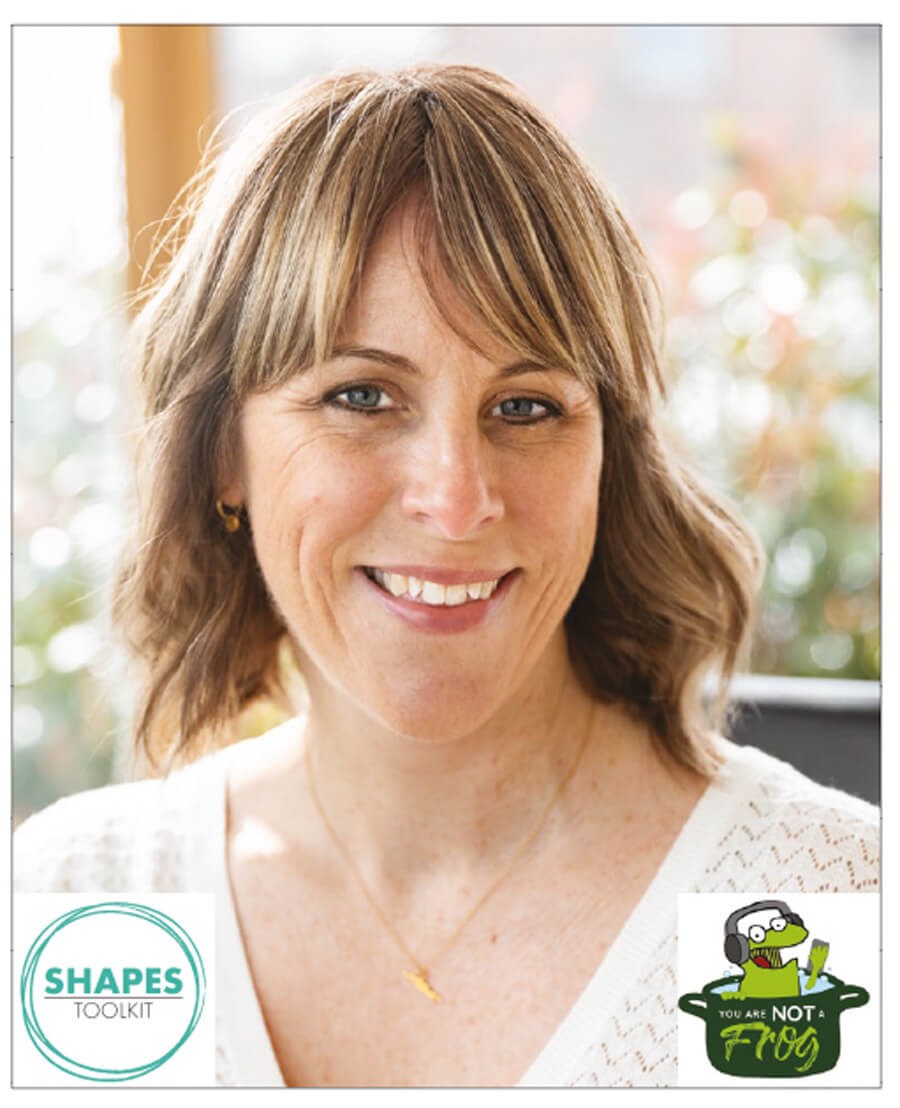
In the last wellbeing supplement, I interviewed Robert Self, Vice President of the Association of Anaesthetists, and we discussed the resources that doctors can access when experiencing problems with their wellbeing. One of those that he recommended was the podcast You Are Not a Frog by Rachel Morris, which provides advice for professionals on how to not only beat stress and burnout, but also to thrive [1].
Following our discussions, I started listening to the podcast on my daily commute and found that it provided enormously helpful advice. Therefore, when it was suggested that I conduct another interview on wellbeing with an emphasis on difficult conversations, I immediately thought of Rachel Morris. I was delighted to be able to catch up with Rachel virtually this autumn.
Rachel Morris qualified in medicine from Nottingham in 1998 and subsequently worked as a general practitioner (GP) in Cambridge for nearly 20 years. During her time in general practice, she led the Professionalism Programme at the University of Cambridge and also co-created and presented the ‘Red Whale Lead, Manage, Thrive!’ course for primary care. However, she subsequently left medicine and set up a training organisation with an emphasis on beating stress and thriving for professionals in healthcare, and also You Are Not a Frog. I asked Rachel how this change in her career pathway came about.
“I came to a point where I was simultaneously bored and stressed working as a GP, which was a bad combination, and I just wanted to do something a bit different. I have also always been interested in self-development. Whilst I was training as an executive coach, I came across some tools and models which I wish I had learnt 20 years ago when I first graduated. So, I put them together to create the Shapes Toolkit Resilience Training Programme and started the podcast and it really took off, so I ended up doing it full-time.”
The name for You Are Not a Frog, which is consistently in the Apple Top 100 UK Business Chart, came from an article in the British Journal of General Practice in 2016, which discussed the reasons why GPs under the age of 50 were leaving the NHS. Many different reasons were mentioned, but the predominant one was the impact of their work on their wellbeing, and GPs were compared to frogs in boiling water [2]. The allegory is that if you put a frog in boiling water, it will jump out straight away, but if you put it in cold water and you heat it up slowly it will be boiled alive. “The workload as a GP has crept up over the last 20 years such that 12-hour days is now the norm,” Rachel explained. “What options do you have as a GP? You can leave or you can burn out. Those are the only options if you are a frog. But you’re not a frog, there are other things you can do and that is how the name for the podcast came about.”
I wanted to know Rachel’s thoughts on why doctors are increasingly running into problems with their wellbeing. She believes that the main reason is that doctors are prone to over work. “We’ve always been successful because we have worked hard. Our success is predicated on how hard we have been working. We believe we will be happy if we are successful and the only paradigm we have for that is working really hard and achieving more and more. However, when the workload is limitless, you can never actually get to the end of your to do list. We also find it very difficult to say no and set boundaries. We then feel this great big sense of shame that we can’t be everything for all people and that often hits our inner values. We work as hard as we can and our default mode is to work even harder, but unfortunately this doesn’t work and ultimately leads to burnout.”
Rachel feels that the second reason is that most doctors are good people and genuinely want to help people, but their efforts can be misplaced and they find themselves in the rescuer role of the ‘Drama Triangle’. This is a model of dysfunctional social interactions, first described by Stephen Karpman in the 1960s, which involves three roles: rescuer, victim and persecutor [3]. “When we work in teams that aren’t coping with the workload, we jump in and say we can do it. When we are with patients and there is nothing we can do, we offer all sorts of different things even though we know they are probably not going to work in order to rescue them. We’re trying to rescue people but we end up with a bigger workload and soon we end up feeling like a victim ourselves. Why is nobody helping me? Then we start blaming other people and become a persecutor. Why aren’t management helping? The rescuer mode for doctors can be very toxic.”

"Burnout is much better prevented than it is cured"
The main topic for our discussion was advice on how a doctor can have a difficult conversation with their line manager about sensitive issues that might affect their ability to work, such as menopause, grief, mental health problems, sexual identity or financial difficulties. Rachel’s initial approach to any difficult conversation would be to carry out a simple ‘zone of power’ exercise beforehand. Rachel explains that this can be very powerful and is simply a circle that shows what is in your control and what is outside your control. So, for example, if you are struggling with symptoms from the menopause, it is important to do a zone of power and ask the following questions:
- Have I done everything that I can do for myself right now?
- Have I told my own colleagues what is going on for me?
- Have I gone to the doctor and discussed how I can sort out my hormones?
- Have I done everything outside of work to rest and to give myself the space and the time I need to actually cope?
- Have I got the right support around me, like my friends and my colleagues?
- Am I regularly meeting up with other people in the same boat, people of my age, or others who I know have got my back?
“That sort of support should be your first point of call and can be much more effective than getting support from your organisation, who often have limited resources and ability to support you,” Rachel added.
When you decide you want to have a conversation with your line manager, it is important to establish prior to any meeting what your higher intent is. It may be that you want to change your job plan and drop some sessions. However, you need to have an idea of what will work for both you and the department. An example of a higher intent would be to think about how to get the best for both sides at the same time. “I want to be able to carry on working here in a way that’s going to work for you and is sustainable for me. I’m worried that if I carry on (in this way), I might burn out or not be able to cope.” It’s knowing what you want from the conversation but also showing that you care for the other person as well.
I asked Rachel about how to approach any potential conversation and whether there are any strategies she can recommend. She explained that there all sorts of negotiation skills and recommends a book called Never Split the Difference by Chris Voss, a former FBI hostage negotiator. “You are looking for win-win solutions. If you just go in and demand something and threaten people, it will work out badly. There’s a technique called ‘nonviolent communication’, pioneered by Marshall Rosenberg, which is a really great way of having these conversations.”
This is based on a set of principles, the first of which is talking about what your feelings are, such as ‘I’m feeling worried’ or ‘I’m feeling tired.’ Feelings are important because no one can argue with them. After discussing your feelings, it is then important to talk about the impact of the situation.
You might say, ‘I’m feeling really worried because the impact on me of having to do three nights back-to-back when I’m going through the menopause is that I can’t actually function properly for the next 48 hours and then I won’t be at my best for the clinics.’ Then you should always give the other person a chance to respond, listen to them empathetically and reflect back on what they are saying as well.
Once you have shared your feelings and the impact on you, you might want to share what the outcome might be. The impact is: ‘I’m really tired.’ The outcome is: ‘I think if I carry on working like this for another six months I might burn out.’ You are not being threatening, but instead explaining what the long-term outcome might be.
The next thing would be to share your needs as well so know in advance what they are. It might be that you want to do less work. “Nonviolent communication would say that you make a request of the other person. You don’t demand; you request. ‘Would you be willing…?’ or ‘It would be great if you could…’ You make a request and give the other person a chance to respond because it’s a dialogue.”
Rachel went on to explain that she has created a particular model called ‘High Five’ for these difficult conversations. The ‘High’ is the highest intention. The ‘F’ is to describe the issue using facts and observable behaviour. “Keep that as non-judgemental as you can. In communication skills, we talk about descriptive feedback. So, rather than saying, ‘you were really angry there,’ you should say, ‘I noticed that you raised your voice and your cheeks went red.’ You’re not putting any judgement on people.” The ‘I’ is highlighting the impact and the consequences of it. The ‘V’ is inviting the response from the other person by getting very, very curious. “This is where people fall down. Both sides say what they want but they get into a battle. It’s important to ask questions of the other person. For example, ask ‘That’s interesting but why isn’t this going to work for the department?’ Be curious.” The ‘E’ is for exploring with empathy what you both need. You are trying to establish both sets of demands and working together to achieve a win-win for both parties so everyone is getting what they need. “The worst thing you can do is just go in and be combative. You can do that but it isn’t going to work and the relationship afterwards is going to be so difficult.” Rachel highlighted that nonviolent communication for any important conversation is very helpful but getting all the facts on the table first is quite useful. “No one can argue with the facts and no one can argue with your feelings.”
She also added that regardless of whether or not you decide to discuss something uncomfortable with your line manager, it’s important to share anything difficult going on with others. “I always think sharing as much as you can so that other people get the chance of helping or being empathetic is so important. If you don’t tell your colleagues what’s going on for you, even at just a very basic level that there are some issues, then how can anyone meet your needs?”
Rachel also advised that it’s not always helpful to rely on close colleagues in your department to really understand or give you what you need, because if you have something going on, half of their mind will be thinking, ‘What does it mean for me? Will I be able to go on holiday next month? Will I have to cover her clinics?’ If you want really good support then you maybe need to go outside the people you work directly with because what’s going on for you directly impacts on them and it’s difficult for them to be totally independent in their thinking.
I asked Rachel if she had any advice for clinicians to protect themselves from issues with their wellbeing. She recommends some self-development work: “Do some work on your own thinking patterns and mindsets, of perfectionism and people pleasing, so that you can start to set boundaries and say no and put limits around your work. Most of us are workaholics so unless you do that, you’re never going to be able to improve your wellbeing.” She also advises prioritising breaks, exercise and connections with each other.

"No one can argue with the facts and no one can argue with your feeling"
She stated that these are all skills that can be learnt and that she runs a series of online courses and live events which are covered by study leave budgets. One of these is the ‘Beat Stress and Thrive’ course for healthcare workers which teaches these abilities [4]. “Our toolkit is like the advanced life support (ALS) for resilience.” It has six modules covering topics such as time management, wellbeing, mindset, causes of stress at work and difficult conversations. She also runs an annual FrogFest Conference which is a day of talks (similar to TED) for doctors and other professionals, all about thriving in both life and work and designing a life that you’re going to love [5]. A lot of the advice Rachel has is also condensed down into her You Are Not a Frog podcast to fit in with clinicians’ busy lives.
For those doctors that have reached a crisis with their wellbeing such as burnout she recommends making contact with Practitioner Health as the first step (read more on Page4 of this supplement) [6]. She also advises talking to others such as colleagues or family and seeking medical help. It might be that you are not burnt out but that you have just flagged issues up and can carry on with some modifications. “However, most people leave it far too late to do anything about it, but burnout is much better prevented than it is cured. I’m all about the changes you can make before you reach burnout.”
Rachel’s top tips for maintaining wellbeing are ABC. These are: be Active, take regular Breaks, and Connect with people (family, friends and colleagues). She believes that connecting is a priority. “Don’t stick on your own. You might need to be proactive about that connection but it’s so important.”
Her plans for the future include Leapfrog, which is a programme for doctors that are at a career crossroads. “They know something needs to change and they don’t know whether to leave their job or change their role. We will help them with that. It’s not about getting people to leave medicine, it’s getting people to make small changes so that they can thrive.”
To round off our discussions, I asked Rachel what she considered the meaning of life to be. For her, the last line of Mary Oliver’s poem The Summer Day comes to mind, which started her off on her Frog ventures. “I was at a retreat in the Alps and the others there were business people who had moved to the Alps and were working in the morning and going hiking in the afternoon. I thought, ‘That’s amazing. Why can’t my life be like that?’ Then I read the last line of the poem which reads, ‘Tell me, what is it that you plan to do with your one wild and precious life?’ I thought,’Well, right now I can’t move to the Alps and have a wild and precious life, but how can I have a wild and precious life on a Monday morning in the life I’m currently living?’ I really believe that if we try and wait until tomorrow to have this wild and precious life, then we’ll end up just missing the whole point of life. It’s much less about what we do as a career but more about how we are living life in the work that we’re in right now. Life is really short and we need to start paying attention to what it is that makes us thrive and be happy because it is happiness that leads to success and not the other way around.”
References
1. https://youarenotafrog.com
2. Doran N, Fox F, Rodham K, et al. Lost to the NHS: a mixed methods study of why GPs leave practice early in England. Br J Gen Pract 2016;66(643):e128–35.
3. Karpman S. Fairy tales and script drama analysis. Transactional Analysis Bulletin 1968;7(26):39–43.
4. www.shapestoolkit.com/beat-stress-and-thrive-course-healthcare
5. www.shapestoolkit.com/frogfest
6. www.practitionerhealth.nhs.uk
[All links last accessed January 2025]
Declaration of competing interests: None declared.
 This article originally appeared in wellbeing II, published by Eye News. Bayer PLC provided hands-off commercial funding for the creation of this content but has not been involved in its development, review or finalisation.