
Louie: “Allow me to present Pac-Man. Now, who is going to be the lucky pup who gets to play the first game? Iggy! You’re a somewhat compulsive personality. Step forward. Now… you see there’s the maze.”
Iggy: “Uh-huh”
Louie: “All right. You see the little things inside the maze?”
Iggy: “The dots!”
Louie: “That’s right! The dots! Iggy, you were born to play Pac-Man!”
The US sitcom Taxi (1978–1983) features Louie (Danny DeVito), an autocratic and immoral dispatcher. In the episode referenced above, he tries to improve the morale amongst the drivers for the Manhattan-based Sunshine Cab Company by installing a Pac-Man arcade machine in the recreation area of the garage.
He takes advantage of the impressionable and ‘spaced out’ cabbie Iggy by encouraging him to spend all his wages playing the machine obsessively. This he subsequently does, hooked on the hypnotising effects of the flashing lights and electronic noises.
In a similar fashion to the hapless Iggy, I have had my own obsessions throughout my life, much to my kids’ despair. These passions unsurprisingly include 80s movies, 80s music, and as I have mentioned previously, retro arcade games. This account is a continuation of a previous article, ‘Game on’, covering further lessons for life that playing these games has taught me [1].
Gauntlet (1985)
I first came across this game at the ice-skating rink in Queensway, London in the summer of 1985. Ice-skating has never been one of my fortes, with previous attempts bringing to mind Frank Spencer from Some Mothers Do ‘Ave ‘Em. I count myself lucky to have escaped a Colles fracture from the number of times I have fallen on an outstretched hand. However, during breaks from this activity, my friends and I would nurse our bruises with a Pepsi and play Gauntlet.
For the computer game geeks among us, of which obviously I am one, Gauntlet represents one of the first multiplayer ‘hack and slash dungeon-crawler’ arcade games. The gameplay featured a top-down view, where four different characters, an elf, a wizard, a valkyrie and a warrior, explored a series of dungeons whilst being attacked by an assortment of monsters. Gauntlet was ground-breaking because the arcade cabinet allowed four people to play simultaneously and co-operate as the different characters. Obviously, playing with your friends in the same arcade game sounds like enormous fun. It was, but it carried inherent problems.
To begin, there was invariably a stramash over who got to play which character before even putting a coin into the machine. Then there is the fact that ironically the game is easiest to play as a single player rather than multiplayer. Survival in the game is dependent on a health level which diminishes throughout. It improves on eating food and as a single player there is simply more food to go around. Furthermore, in a multiplayer game, fellow players, in a Machiavellian way, would take any nearby food if you were about to die. They would even shoot the food, destroying it deliberately, going against the helpful advice of the game voice prompt: “Remember, don’t shoot food!”
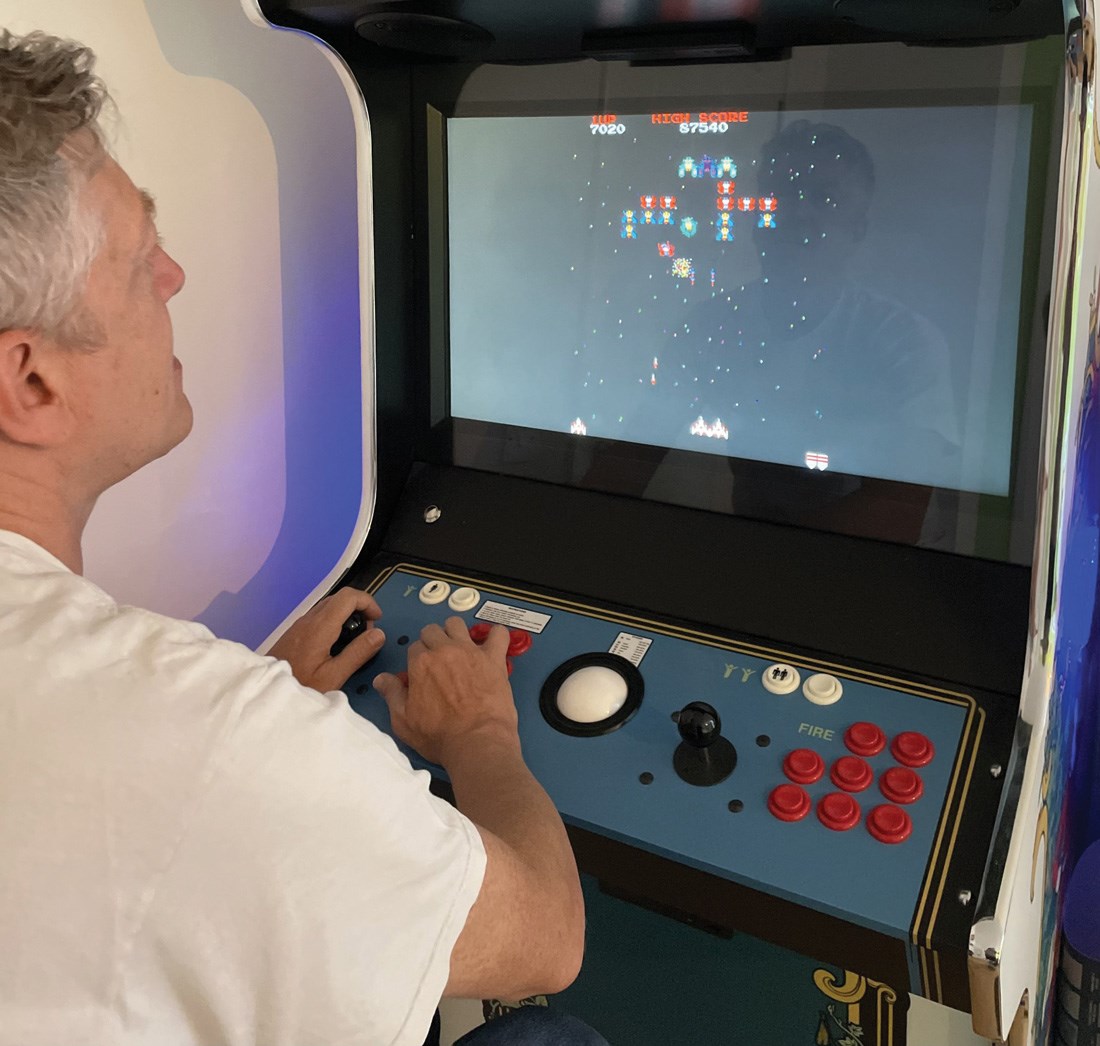
Flying high with the Galaga dual fighter.
This game has parallels in real life. Although working as part of a team has its benefits, it’s sometimes detrimental to success. Functioning well in a career such as medicine will usually necessitate a degree of team working. Even though others actively sabotaging your plans is unlikely, being let down is a distinct possibility. It’s therefore important not to be dependent on or rely on others to get a job done. As Napoleon Bonaparte is reported to have said: “If you want a thing done well, do it yourself.”
Streetfighter 2 (1991)
Streetfighter 2 is considered to be the most important fighting game ever made and is the third highest-grossing arcade game of all time. More than 200,000 arcade cabinets of all versions of this game were sold worldwide. One of these was installed in the St Thomas’s Hospital medical student bar in 1991. Naturally I was attracted to it like Pac-Man to a power pill and wasted many hours trying to hone my fighting skills. However, the bar was not the most conducive playing environment for successful gameplay. One was subject to the rugby club playing loud drinking games nearby, shouting variations of “fuzzy duck,” and other students jostling your arm with their 90p pints of John Smith’s beer. That’s right, Gen Zs, a pint of beer for the bargain basement price of 90p!
The aim of the game is to be the best fighter from a roster of eight ‘World Warriors’ in a series of best of two-out-of-three matches. Each fighter has their own special move, such as Dhalsim’s ‘Yoga Flame’ and Blanka’s ‘Electric Thunder’. These moves are achieved through various joystick movement and button combinations. The key to success in Streetfighter 2 and defeating your opponents is to learn and perfect the special moves.
In the real world, for success in any career, it’s important to develop your own special move – a skill that either only you can do or that you can perform better than anyone else. For example, in ophthalmology it may be the diagnosis and management of the White Dot Syndromes or performing Ahmed Valve implant surgery.
Having that special move will make you highly valuable to any department or organisation with a suitable job vacancy and make you attractive as the potential candidate. In medicine, perfecting your skills in another hospital during a fellowship is becoming almost essential to hone those special skills and become the best in a particular field. Bear in mind though that none of us are indispensable. For as Charles de Gaulle stated: ”The graveyards are full of indispensable men.” There will always be another ‘Streetfighter’ to replace you.
Dig Dug (1982)
This addictive maze arcade game features the cute character Dig Dug manoeuvred to eliminate the screen’s enemies (the Pookas and the Fygars) using falling rocks and an inflating pump. This machine is one of those that I was drawn to in the arcade located on Brighton Pier in the early 80s. The reason why this game features here is because it not only contains a life lesson but recently, it also entered popular culture in the Netflix series, Stranger Things. Given my penchant for all things 80s, I found myself binge watching it with my daughter, revelling in the nostalgia.
In the first episode of series two of Stranger Things, set in 1984, the arcade employee Keith informs an incredulous Dustin that his high score ‘DUSTIN’ on Dig Dug has been beaten by 100,000 points and replaced by the mysterious player ‘MADMAX’. This scene highlights a feature incorporated into the arcade games during the Golden Age of arcade games (late 1970s to early 1980s) which is the ‘High Score’ table. Not only did it give you a chance to get your name ‘in print’ at the local arcade but it also incorporated a competitive element to achieve the highest score [2].
The problem with the high score tables on the early arcade machines is that they would frustratingly be deleted and set to the default scores at the end of the day when the machines were turned off. The sense of recognition and achievement experienced from achieving a high score in these games was therefore brief. From personal experience, during my own career high points, I have noticed that the moments of happiness from success are very fleeting. In my opinion, it’s best not to hold too much store from these goals but to seek contentment in the more rewarding aspects of life, such as relationships with family and friends.
Galaga (1981)
Space Invaders was the first fixed-person shooter arcade game released in Japan by Taito in April 1978. In this game, the player moves a cannon horizontally across the bottom of the screen firing lasers and destroying aliens overhead which are advancing downwards. It was an immediate commercial hit and went on to become the second-highest grossing arcade game of all time. I was hooked as a kid, and no trip to the local fish and chip shop was complete without playing it [3].
Following the success of Space Invaders, a rival company, Namco, developed arcade games of the same genre: first Galaxians followed by Galaga. The innovative and exciting feature of Galaga was being able to transform the player’s ship into a dual fighter with extra firepower. This action is achieved by allowing the ship to be captured in the tractor beam of one of the aliens and then subsequently rescuing it. The additional firepower allows for faster progression through the levels and an increased potential for a high score by clearing all the aliens in the bonus round. However, going for a double ship is a risky strategy as you’re not guaranteed to rescue your captured ship and the dual fighter’s increased size is more vulnerable to the aliens’ lasers. But it is more exciting. Galaga was also a commercial hit and made cameo appearances in popular 80s movies including WarGames (1983) and The Karate Kid (1984) [4].
In real life, most people attempt to seek out their own dual-fighter scenario in a long-term relationship, which is evidenced by the plethora of online dating apps now available for those seeking out their one true love. Having the ‘dual ship’ by your side can be exhilarating and make the journey through life so much easier and pleasurable. A partner can provide support, companionship and a sense of belonging, which all contribute to enhance one’s wellbeing.
However, there are many aliens raining lasers down along the way, threatening to destroy the relationship. There may be a time when, for whatever reason, the other fighter you had by your side is no longer with you. Although this can be devastating, it is important to remember that if you find yourself journeying through the screens of life as a solo ship again, it can still be fun and rewarding. Whilst you still have a fighter in the game and credits in the machine of life, you have the potential to find another ship to fly alongside you and reach that elusive high score!
To finish up, returning to the Taxi-Pac-Man episode, Iggy ultimately becomes frazzled from constantly playing Pac-Man. He turns away from the machine saying: “I don’t know why I play this game. Throbbing noises, flashing lights, monsters chasing you. I get enough of that in real life.”
I can fully empathise with Iggy’s sentiments.
Postscript
Being immortalised in one’s field is a quest many of us have. In the Golden Age of arcade games, designers would immortalise themselves by programming their initials into the default scores and ensure that their legacy would live on in the machines. At Atari, there were unofficial competitions to decide whose initials would be used.
In medicine, one of the forms of this immortality is the eponym, such as the Argyll Robertson and Marcus Gunn pupils. Frustratingly, however, having your name as a medical eponym is nigh on impossible now as most diseases, signs, etc., have already been discovered. Time travel in a DeLorean back to the early 1900s armed with a medical textbook to claim all the yet to be discovered eponyms represents my only chance for immortality in medicine.
References
1. Cackett P. Chapter 16: Game On. In: Pete’s Bogus Journey: An Autobiographical Descent through a Career in Medicine. World Scientific Publishing Co; 2023:89–94.
2. Dig Dug was one of several classic arcade games that had a ‘kill screen’, which is a point in the game where it is impossible to progress due to a design oversight or programming error and the screen crashes. In Dig Dug, this stage was level 256. If you ever reached a ‘kill screen’, then you were truly a Jedi Master of that game.
3. Space Invaders in the fish and chip shop was subsequently replaced by a Defender machine in 1981, a notoriously difficult game to play with a fiendishly complex control system. I never had sufficient spare 10ps to be able to master it. My consolation prize was that my chips never had enough time to get cold.
4. In the movie WarGames, we see David (Matthew Broderick) playing Galaga (with a double ship!) before school at the 20 Grand Palace arcade. As the camera pans across the arcade, it’s good to try and spot all the old arcade games and see how many you can name. I’ll get my coat…





