Diabetic retinopathy (DR) is a leading cause of moderate to severe visual impairment (VI) and blindness worldwide, posing a significant public health challenge. As the prevalence of diabetes continues to rise globally, particularly in low- and middle-income countries (LMICs), the demand for DR services is increasing at an alarming rate. With Tanzania having one of the highest diabetes prevalence rates in sub-Saharan Africa, the need for effective DR screening, treatment and prevention strategies has never been more urgent [1].

Figure 1: Delegates attending DR National Workshop at KCMC, Moshi.
To address this growing challenge, the Diabetic Retinopathy Network (DR-NET), in partnership with the Tanzanian Ministry of Health, organised a National DR Workshop hosted by the Kilimanjaro Christian Medical Centre (KCMC) in Moshi. The workshop brought together key stakeholders, including representatives from the Ministry of Health, eyecare providers, diabetes specialists, patient advocacy groups and non-governmental organisations. The event aimed to assess the current state of DR services in Tanzania, identify gaps in care and explore strategies for strengthening coordination between DR programmes.
A key focus of the workshop was to build clinical capacity by training healthcare workers in best practices for DR screening, diagnosis and treatment to improve overall service delivery. Discussions also centered on the latest advancements in artificial intelligence (AI) for DR screening, presenting recent evidence on its application in Tanzania and outlining plans for its national-scale implementation. These efforts mark a crucial step toward improving DR care and preventing avoidable vision loss across the country.
Dr Omary’s MoH policy recommendations
As a result of the discussions, the MoH proposed the following measures to enhance the screening and management of diabetic retinopathy in Tanzania:
-
Mandatory screening: Patients with diabetes should undergo screening for DR.
-
Screening target: At least 90% of newly diagnosed diabetes cases should be screened for DR.
-
Unified patient register: All hospitals should maintain a standardised register for DR patients.
-
Referral algorithm: Develop an algorithm based on patient history to facilitate care including referrals and verify whether a patient has undergone the recommended screening, at least at the primary healthcare level.
-
Electronic medical records (EMR) enhancement: Improve EMR systems by incorporating additional requirements for the documentation of DR screening as part of diabetes complications management.
-
Healthcare worker training: Hospital management must ensure that at least 90% of healthcare workers in diabetes clinics are trained in DR screening.
-
Patient follow-up: Hospital management should ensure that at least 80% of DR patients receive consistent follow-up care.
-
Fundus camera accessibility: All diabetes clinics at regional referral hospitals or above should be equipped with at least portable fundus cameras to facilitate DR screening.
-
Hospital referral justifications: Hospitals referring DR patients despite having the necessary human resources will be required to provide an explanation.
-
Patient diary system: Each patient will be given a diary to record the dates of past and upcoming DR screenings, follow-up visits, and other diabetes-related complications. This will enhance patient awareness and adherence to necessary medical appointments.
Policy and planning
DR integration and policy
The workshop was officially opened by Dr Omary Ubuguyu, Assistant Director of Non-Communicable Diseases at the Ministry of Health (MoH), alongside Dr Bernadetha Shilio, Programme Manager from the National Eye Care Programme. Their remarks highlighted Tanzania’s long-standing collaboration with the UK through the VISION 2020 LINKS Programme, which has evolved from isolated hospital-based DR initiatives into a coordinated national programme under MoH leadership.

Figure 2: Shilio, National Eye Care Programme Manager, Ministry of Health, addressing delegates.

Figure 3: Omary, Assistant Director of Non-Communicable Diseases at the Ministry of Health (MoH).
With the increasing burden of DR, it was emphasised that DR screening should not be conducted in isolation. Instead, it must be fully integrated into existing diabetes care services to ensure early detection. Additionally, strengthening links with eyecare services is essential so that patients diagnosed with DR have access to timely and appropriate treatment.
The workshop reinforced the need for national policies that formalise DR service delivery, enhance resource allocation and establish clear referral pathways to guarantee continuity of care. By embedding DR care into Tanzania’s broader non-communicable disease (NCD) strategy, policymakers aim to ensure that DR screening, treatment and follow-up care become routine components of diabetes management. This integrated approach is expected to improve patient outcomes, reduce preventable blindness and create a sustainable framework for DR care in Tanzania.
Laser training in Tanzania
by Mr Moin Mohamed, Consultant Ophthalmic Surgeon, Guy’s and St Thomas’ NHS Foundation Trust.
The hypoxic struggle to climb Mount Kilimanjaro, which provides a dramatic backdrop to the lush green campus of KCMC in Moshi, is an apt metaphor for the ophthalmic public health timebomb which Tanzania faces.
The prevalence of diabetes has quadrupled in the past decade, however, there are only 130 ophthalmologists in a country of 66 million people. This is thrown into context when noting there are 3500 ophthalmologists in the UK for a similar sized population.
Other barriers include the fact that only a handful of functioning retinal lasers exist, in the six major public sector hospitals serving the entire country, whose population is spread over an area four times that of the UK, making healthcare even more difficult to access.
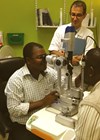
Alongside the National Diabetic Retinopathy Workshop, convened to formulate a national strategy to tackle this impending problem, I had the opportunity to undertake some in- depth teaching on pan-retinal photocoagulation (PRP), with six retinal specialists, and separately for the 12 senior residents at KCMC, one of the largest training schools for ophthalmologists in East Africa.
We discussed in detail the key issues relevant to delivering an effective PRP: when to initiate treatment, how to execute treatment, how to gauge and assess the treatment response, what a re-treatment cycle entails, and importantly, recognising when to change the approach if the disease is not responding to laser therapy.
One key concept introduced was that ultimately the spot size delivered at the retina (taking into consideration the magnification factor of the lens used) and number of burns applied, equates to an area of ablation akin to a ‘dose’, and undertreatment remains one of the main causes of treatment failure, especially when reducing the spot size. Other parameters discussed included the power and duration of the burns, which dictate the burn grade and morphology; factors essential to understanding whether the treatment will be effective. A further fundamental point covered was that ‘pattern scanning’ lasers inevitably require significantly more burns for an equal treatment effect in comparison to a ‘standard’ ETDRS PRP.
To assess the effectiveness and impact of the training, prior to the session, we questioned every individual participant’s understanding of what a standard laser treatment entailed – this was highly variable across the group with a poor general grasp of the treatment parameters.
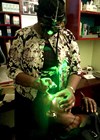
Following the session there was an opportunity to reinforce the teaching by using the excellent QUILT laser simulation software in a supervised session, in which there was a uniform improvement in the understanding and mechanism of delivery of PRP [3].
It is always a humbling experience visiting the eye departments in Tanzania, as part of the ongoing VISION 2020 LINKS and Networks Programme, and appreciating the challenges and adversity faced by our colleagues around the globe. The DR-NET provides a valuable opportunity for capacity strengthening in DR and it is encouraging to see the Tanzania national DR programmes progress.
Situational analysis of DR services in Tanzania
The situation analysis of DR services in Tanzania revealed some disparities in access to screening, treatment and trained personnel across different regions. Data from key hospitals, including Kilimanjaro Christian Medical Centre (KCMC), Muhimbili National Hospital, Bugando Medical Centre Zonal Hospital, and Mbeya Zonal Referral Hospital, highlighted gaps in human resources, equipment and service delivery.
One of the main challenges identified was the uneven distribution of trained healthcare professionals, with a limited number of screeners, graders and specialists qualified to perform retinal laser treatments and administer anti-VEGF injections. This limits their capacity to screen and treat patients effectively.

Figure 4: Human resource capacity for DR laser treatment. Abbreviations: Kilimanjaro Christian Medical Centre (KCMC); Muhimbili National Hospital (MNH); Mbeya Zonal Referral Hospital (MZRH); Bugando Medical Centre Zonal Hospital (BMCZH); Benjamin Mkapa Hospital (BMH).
The availability and functionality of essential diagnostic and treatment equipment has significantly improved in the last decade. However, while some facilities had operational retinal cameras, optical coherence tomography (OCT) machines and laser equipment, others faced technical failures and maintenance issues that hindered service delivery. Additionally, most facilities have only one functioning retinal camera, which is not portable, presenting difficulties in deploying it to the diabetes clinics in their catchment area.
The frequency of DR screening also differed significantly between hospitals, with some centres conducting regular screenings while others had limited outreach due to resource constraints. These gaps underscored the urgent need for increased investment in infrastructure and training.

Figure 5: DR diagnostic and treatment equipment per facility. Abbreviations: Kilimanjaro Christian Medical Centre (KCMC); Muhimbili National Hospital (MNH); Mbeya Zonal Referral Hospital (MZRH); Bugando Medical Centre Zonal Hospital (BMCZH); Benjamin Mkapa Hospital (BMH); Optical Coherence Tomography (OCT); anti- vascular endothelial growth factor (Anti-VEGF).
Overall, the findings emphasised the importance of a nationally coordinated approach to DR management, ensuring equitable distribution of resources, sustainable service delivery and enhanced capacity-building efforts to address the rising burden of diabetic retinopathy in Tanzania.
Training
An identified area of training need for ophthalmologists in Tanzania is in the delivery of retinal laser treatment for proliferative DR and maculopathy. These are long-established, safe and effective treatments that prevent vision loss and blindness for people with the most severe forms of DR [2]. However, access to retinal laser treatment remains limited in Tanzania and within the current ophthalmology clinical training programme, there is no structured intense retinal laser training.
This initiative addresses a critical gap, as many ophthalmologists currently complete residency training without adequate hands-on experience in retinal laser treatment. As a result, some ophthalmologists finish their residency training but lack the confidence and skills to independently deliver effective retinal laser treatment.
As part of this DR-NET workshop, a retinal laser training course was delivered with the final year ophthalmology residents from the KCMC eye department. The longer-term aim is to integrate structured training in the delivery of retinal laser treatment into all the ophthalmology residency training in Tanzania.
This pilot course consisted of both lecture based and practical teaching. Dr Moin Mohamed, lead for the long-standing VISION 2020 LINK between Muhimbili National Hospital and St Thomas’ Hospital, led the lecture-based teaching which provided residents with training on the principals of retinal laser treatment and the evidence base that underpins this [2].
Technology
There is good evidence that screening for DR can prevent vision loss and blindness from the condition. However, DR screening programmes are expensive to operationalise, and this has limited DR screening coverage in many LMICs. The last 5–10 years has seen significant technological progress which is making screening for DR more cost-effective and easier.
Traditional tabletop fundus cameras typically cost in excess of £20,000 and are bulky and difficult to move around, often being linked to a desktop computer. However, there are now several lower cost, portable fundus cameras which have come to market and provide an alternative to traditional cameras. These portable cameras are generally around 10–20% of the cost of traditional tabletop cameras and there is good evidence that they can produce high-quality retinal images which can be used for DR screening. Moreover, they can be much more easily transported to different locations, helping to increase screening coverage.
A separate challenge for low-resource settings has been access to specialists who are needed to grade retinal images for the level of DR. In Tanzania, there are 130 ophthalmologists, with the majority based in the urban tertiary hospitals. Given their wider clinical commitments, they often do not have the capacity to develop and run DR screening programmes. The application of AI, which automates the grading of retinal images for the level of DR, is another area of rapid technological progress which is making DR screening easier and more feasible.

Figure 6: Moin Mohamed and Charles Cleland with the senior ophthalmology residents that were trained in laser treatment of diabetic retinopathy.

Figure 7: Laser simulation training (QUILT).

Figure 8: AI demonstration by Lusekelo Nyale.
There are now several AI tools which are licensed for use in DR screening programmes. There is a growing body of evidence that these AI devices can safely and accurately identify and refer people with potentially sight-threatening DR who attend screening. Additionally, some of these AI devices integrate with lower cost portable cameras, thereby helping to improve screening coverage and access to high-quality diagnostics for historically underserved populations.
As part of a randomised controlled trial in Tanzania and in collaboration with the MoH, an AI system has been successfully implemented into a regional DR screening programme, to investigate whether AI with a point-of-screening result and face-to-face counselling can improve referral compliance, a major challenge for programmes [4]. This partnership with the MoH, is now beginning to operationalise AI screening for DR in four regions of Tanzania.
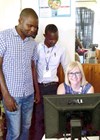
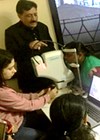
A live demonstration of AI screening for DR was given to delegates attending the DR-NET Tanzania Workshop. Using AI for DR screening does not require expensive equipment and hardware and is a feasible solution for a low-resource setting, such as Tanzania. The only requirement is a laptop (or smartphone) which has the AI software installed on it. Both of the AI devices demonstrated to delegates function offline and simply require the user to drag and drop JPEG retinal images into the software platform and then click submit. The user is then told after a few seconds whether the patient has ‘non-referable’ or ‘referable’ DR and the patient can receive their result straightaway.
The lower cost of portable cameras coupled with advances in automated AI diagnostics mean there is real potential to rapidly increased DR screening coverage for underserved populations. If this can be coupled with strengthened referral pathways and more effective retinal laser treatment, vision loss from DR can be prevented.
The DR-NET National DR Workshop in Tanzania, in partnership with the MoH, highlighted the urgent need for strengthened policies, enhanced training, and the adoption of innovative technologies to improve DR services. The discussions emphasised the importance of integrating DR care into national health systems, ensuring access to treatment alongside screening and equipping healthcare workers with essential skills. With advancements in AI and cost-effective screening tools, Tanzania has a unique opportunity to expand DR coverage, prevent vision loss, and enhance patient outcomes. The workshop set a strong foundation for future collaborations and sustainable DR interventions in the country.
References
1. Bascaran C, Zondervan M, Walker C, et al. Diabetic retinopathy in Africa. Eye (Lond) 2022;36(Suppl 1):1–3.
2. Astbury N, Mabey D, Kilemile J, et al. Diabetic Retinopathy Network laser training programme. Eye News 2020;26(5):22–5.
3. www.quiltsystem.com
4. Cleland CR, Bascaran C, Makupa W, et al. Artificial intelligence-supported diabetic retinopathy screening in Tanzania: rationale and design of a randomised controlled trial. BMJ Open 2024;14(1):e075055.