Nick Astbury caught up with President of the Ophthalmology Society of Uganda (OSU), Faith Nakubulwa, and Angela Birungi, Scientific Chair for OSU, to discuss their key learnings taken away from the RCOphth 2026.
Nick Astbury (NA): One of the key activities of the COECSA-RCOphth LINK partnership has been exchange visits to our College meetings in the UK. You visited the Manchester RCOphth Annual Congress in May 2026. How did you find the experience?
Faith Nakubulwa (FN): Thank you. I attended the RCOphth Congress and I would like to give all credit to the LINKS partnership. I can’t emphasise any deeper the importance of the longstanding partnerships that have grown over almost 20 years.
As the president of OSU, I’ve just been in office with my team since November 2025, but we have laid out a strategic plan for our three years in office in which we have a vision to improve eyecare services, training and professional development. We hold monthly, continuous learning sessions for all our members and we are very keen to grow partnerships that help us bridge the gaps in eyecare delivery that we have in our region, which brings me to your question.
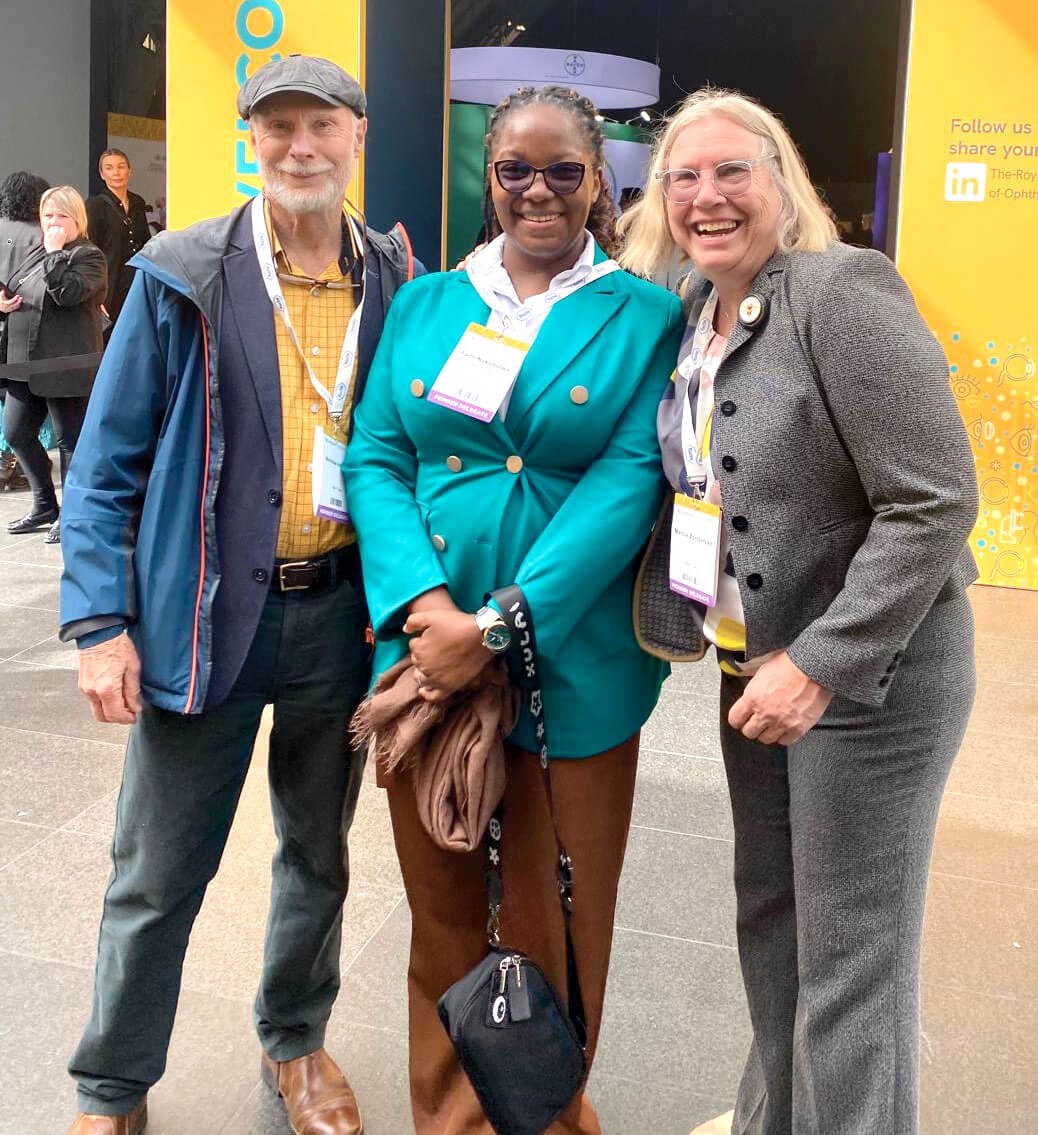
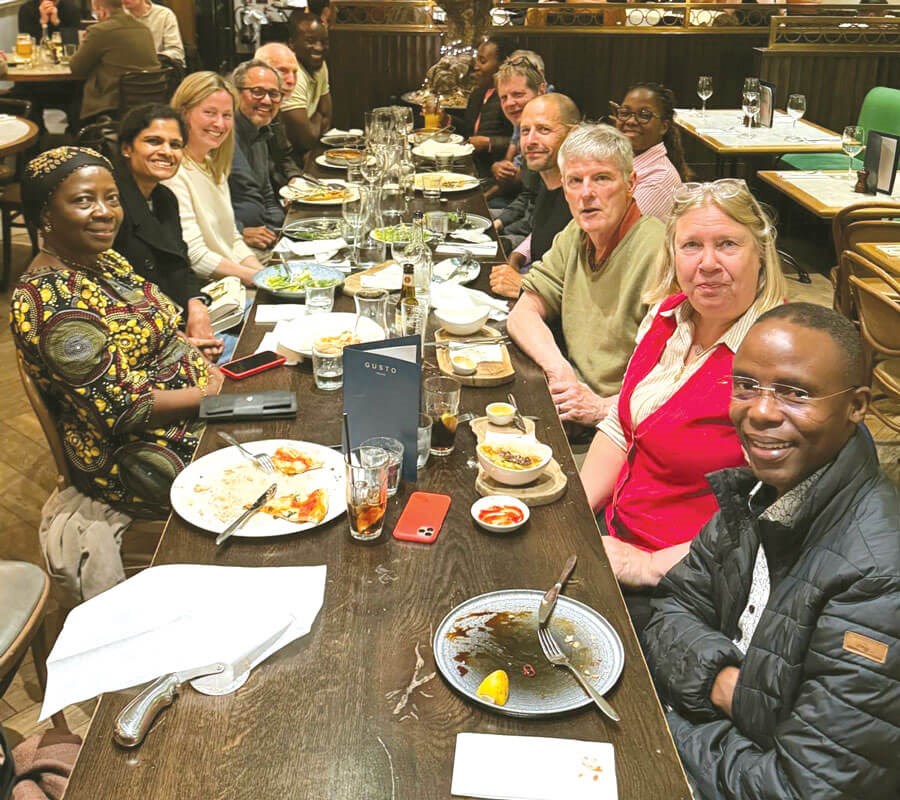
(L-R) Nick Astbury, Faith Nakubulwa and Marcia Zondervan at RCOphth 2026.
I can’t downplay the importance of virtual meetings, but physical meetings still help us – we get rid of so many stereotypes; we break so many barriers. My attendance at RCOphth was one of those physical meetings which I believe has opened doors to many longstanding partnerships.
With regards to my experience at Congress, it was inspirational, full of learning. And of course, being my first time in Europe, it was a change in environment, starting from the culture and the weather. Right from the registration process, it was interactive, where someone got real-time help without grudges, the kind of help that comes because the person has the heart to do it but also loves to do their job. Having a barcode sent before time – we don’t experience it here – it was a great innovation, as by the time I got to Congress I just had to scan my barcode to be registered. So even that process was smooth and seamless.
The trade exhibition was fabulous, a blend of science and innovation. There’s the science of the things we know are happening, but then the quality of diversity there, all in one room – you just have to turn and get the latest innovation in, let’s say, the treatment of thyroid eye disease, or tips and tricks for reading the retina.
In the exhibition area, I liked the fact that they kept thanking their sponsors and exhibitors. As Africans, we are really grateful people, and we like saying thank you all the time. So, it was impressive to see that you recognise people who invest their money and time to see that the Congress happens.
The networking sessions were one of the most fruitful for me. Getting to meet so many people who come from different walks of life, different practices – the world has brought them to you, so it’s up to you to either utilise them or shy away. My experience in the coffee breaks was not just a coffee – each time we went, I made sure I met somebody that I didn’t know before. From that, I actually met two doctors, one of whom is going to come to our Congress as a speaker, and the other, an oculoplastic surgeon, promised to do a charity camp when all is safe. I also had a talk with Steve Knight, the head of the whole exhibition, and he offered time to elaborate how they achieved what they did, and it was a worthwhile experience. There are notes I took that I believe are going to help us here in Uganda.
Then we had a social event, the evening at the Manchester Art Gallery. So again, the people that I was not able to meet because of how busy the programme was, there was always an opportunity to meet them outside the walls of the Congress. We had fun at the gallery and I was able to interact with professor Ben Burton, the immediate past president, and current president, Mohamed Elalfy, in a more calm and relaxed setting.
These social interactions outside the scientific programme are essential for people who want to connect. It was from there that I was able to say how thankful I was to the RCOphth and how I was enjoying the experience and learning as much as I could. And it’s through the exhibition that I saw the Eye News desk, which is how I met Samuel and that’s why this conversation is happening.
NA: You’ve talked about a lot of key people whom you met and the importance of those meetings. Now that you’ve been to the Congress and you’ve talked to Angela Birungi, the scientific chair for the Congress in December, what can you take from your visit to help you with the College of Ophthalmology of Eastern, Central and Southern Africa (COECSA) Congress in August?
FN: I will start with the delegate experience. The communication before the Congress – the registration, how clear the directions were, what sessions were happening – can either sell the Congress or downplay it. We sometimes ignore the experience that every delegate is getting from that, which we hope to implement as a team to improve our congress.
The next thing is creating time for networking outside the Congress. People don’t only come to learn; they come to create partnerships, to meet new people, so it’s important that we allow them that time – not having one scientific session after another, because you barely get time to say hello to your neighbour.
Then, delivering a high-quality scientific programme, from the selection of who is coming to speak and what topics are going to be addressed, or which subspecialty sessions we will have, to making sure that we allocate enough time for the different sessions to be dissected maximally and understood by people attending them.
Of course, the exhibition we can try and copy, but we are still a low-income country, so we might not pull off a very grand exhibition, but we’ll do our best with the resource baskets that we have to see that even the exhibition at COECSA can emulate our mentors at the RCOphth. The way the exhibitors are recruited and how we talk to them also influences who is coming onboard and who is staying. Some may come for a year and leave, but the interaction with those people who support the Congress is important, because most of the money that runs the Congress usually comes through the sponsors and exhibitors. I learnt lessons from Steve Knight and that’s a critical aspect that we need to pay attention to, because it’s the backbone of the financial muscle for the event.
NA: Something that I think is very valuable is getting feedback from delegates, which you may have done after previous COECSA congresses. It’s something that our College is very keen on, to try and learn what went well and what they didn’t enjoy so much, for future congresses. What did you think of the overall quality of the sessions at the Congress?
FN: They were good. I attended one on how to pass the strabismus exam for the College Fellowship, and it was interesting how the examiners themselves were opening up to their students and telling them why they fail and encouraging them to do better, showing them exactly what has to be done and where they go wrong. This isn’t a culture here in Uganda and yet it should be – to know that professors are not there to kill them; they’re there to help them pass.
NA: And they’re just human beings like everybody else!
FN: Yes, I will leave the topic of the programme for Angela, but I really want to thank the RCOphth for holding up and seeing that this LINKS programme is still moving. It’s been over two decades and I’m sure I’m not the first beneficiary, but it’s an eye-opener. It changes the way you see things. If you’ve been comfortable thinking that you were doing your best, then you meet a challenge. And also thanks to COECSA, which is my mother society, my mother College, for enabling this partnership to stay. Sometimes we enter into partnerships and then get lazy to nurture them, but I thank them for trying up to this point. I believe the future is bright and if we continue to grow this partnership and grow the LINKS, including the link between RCOphth and COECSA, we can build something bigger than it has ever been, make it blossom and benefit a lot more people. What we learned in Manchester, we will translate into actionable points back home. Not just the theory, but the practicability of our practice.
NA: Thank you, Faith. Now, Angela, could you briefly introduce yourself.
Angela Meric Birungi.
Angela Birungi (AB): Hello, I’m Angela Meric Birungi, a general ophthalmologist practising at Mengo Hospital in Kampala Uganda. I serve as the Scientific Chair for the Ophthalmology Society of Uganda (OSU) while at the same time, I’m the scientific chair for the upcoming COECSA Congress.
NA: That’s a lot to take on. Well done for your achievement. Although you weren’t able to come to our RCOphth Congress, have you been able to derive some benefit from conversations with Faith that could help you with your scientific programme?
AB: I was unfortunately unable to attend the Congress as I had planned. Despite the frustration, I felt the team were empathetic and really tried to help me. I kept imagining how many delegates encounter challenges and frustration in the process of being able to attend such meetings! I learnt that we should be intentional about making the process smooth for our delegates, to give them guidance on what they should expect in preparation for the Congress in terms of Visa application, transportation, accommodation, flights, etc. That is something we sometimes overlook and yet it is very, very important. By the time someone reaches the venue, they have gone through a process which might either be frustrating, or it might be a good experience. Amidst the frustration, the delegate should feel cared for such that in a circumstance where they have not been able to attend, they will appreciate the support of the team on the ground. This way, the delegates feel encouraged and maybe next time, they’ll try again. So, at this point, I really want to thank you and Marcia Zondervan and the entire team that reached out to support me despite all the challenges.
On the other hand, I was happy that at least Dr Faith managed to attend and represent us. She shared lots of learning points and these were my major take away points:
- Punctuality. For most of the congresses I’ve attended, yes, there is a lot that has been prepared, but then presenters are cut short because of time. This speaks to a great programme and encouraging all speakers and delegates to respect time so as to allow meaningful engagements without ‘rush hour’ incidences.
- I looked at the layout of the programme and it was beautifully and thoughtfully put together. On just a single page, you’re able to glance at almost everything that is going to happen. The titles were also very eye-catching, which was interesting. For example, ‘Can I divorce my colleagues?’ This caught my attention and it really encourages people to attend these different sessions, but also speaks to the topic and helps someone pick out what might be the gist or the content, rather than just ‘Cataract session’ or ‘Retina session’.
- A lot of innovations were showcased at the Congress and this made me think about our own theme for the upcoming Congress: ‘Innovating together for equitable and sustainable eyecare’. Congresses bring together people from all over the world and the innovations are huge, but also in our local setting, I believe there are many people who are doing small, powerful things which might be overlooked, and yet there are great innovators in our setting. My team and I have gone back to the drawing board to lay strategies of encouraging people to share their low-cost innovations – for example, better ways of increasing post-surgical patient follow-up, screening and many more – which fits so well in the African context.
- Rapid-fire sessions for the abstracts as well as awarding the best abstract was also a good learning point for me. Critically analysing the written or poster abstracts, the presentation and ability to discuss scientific facts stirs up meaningful engagements. This is also very important for promoting research, especially among the residents and young ophthalmologists who sometimes feel like they are being left out at such big congresses.
- And last but not least, a reflection on how we promote the COECSA exam. At the RCOphth congress, there were sessions on how to pass the FRCOphth exams, which I feel we are not doing sufficiently. At our Congress, we shall be very intentional about COECSA exams, the benefits of becoming a fellow, how to prepare and what to expect in the exam. This way, we can promote the culture of doing COECSA exams because they are a brilliant means to standardise training and practice and stimulate knowledge within the region.
As I conclude, I once again thank the Royal College of Ophthalmologists and the VISION 2020 LINKS programme. Thank you very much for the support and the collaboration. It’s really important to us to know that we have people out there who really mind about eyecare in Africa, and about professional development. And through this partnership, we can become better as individuals, we can get better at our service, and all of this will trickle down to the eyes of every individual. And at the end of the day, it won’t just be about ‘VISION’ in words, but it will also be about the vision for an individual to see better and have a better life. Thank you very much.
NA: Very well spoken, Angela. I can see how you are the scientific lead and how Faith is president. You both have great qualities and I’ve enjoyed speaking to you both. Thank you very much indeed.