
King’s College London (KCL) Ophthalmology Society 2024/25 hosted the third Annual KCL Ophthalmology National Conference 2025, entitled ‘Advancements and the Future of Ophthalmology’ in London on 5 April 2025.
Held at Guy’s Campus, the event drew a wide audience from across the UK, including KCL, University College London and Imperial College London, amongst others across the country. This event aimed to provide delegates with insights into the field, covering numerous subspecialties, hands-on opportunities, discussion of research, and networking, tailored towards medical students and junior doctors keen to explore the field.
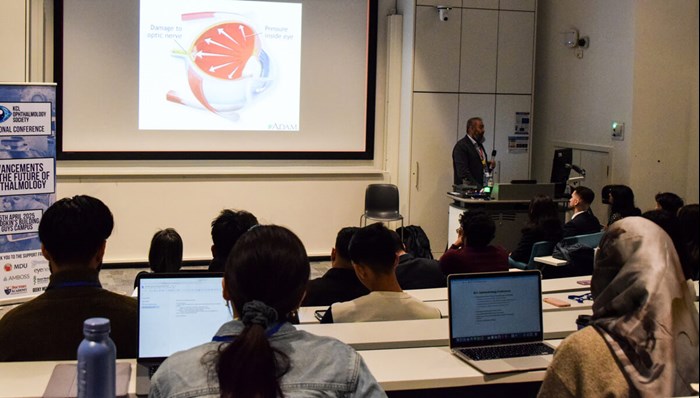
The programme consisted of morning lectures given by world-class experts in ophthalmology, oral presentations, and varied workshops in the afternoon. Following the President’s introduction, the first talk was on ‘Predicting referable diabetic retinopathy using deep learning’ by Paul Nderitu, exploring how deep learning can use retinal images to enhance diagnosis and support screening. The second talk was on ‘Glaucoma: Past, Present and Future’ by Mohammed Abu-Bakra, describing the mechanisms of glaucoma and the changes in investigations of management, spanning the past, present and future. The third talk was on ‘Suspected disc swelling? What to do next’ by Sui Wong, discussing interactive cases for typical and atypical patient presentations. The fourth talk was on ‘Cataracts surgery: 75 years on from Harold Ridley’s world first’ by Professor Christopher Hammond, exploring the history of cataract surgery. Oral presentations followed, enabling discussion amongst speakers, presenters and delegates, on topics including retinal disease and glaucoma.
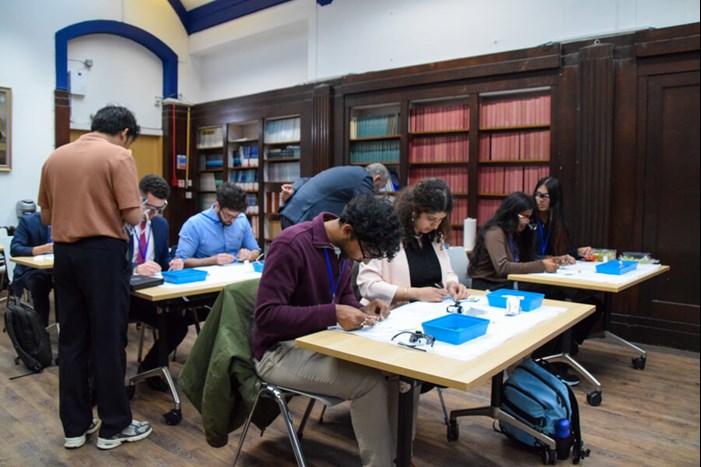
The afternoon workshops included portfolio guidance, an experience of ophthalmology through VR, an AI hackathon-style workshop, and a microsurgery workshop. The ‘Ophthalmology ST1 Application & Portfolio’ workshop was run by Haider Manzar, supporting students to optimise their portfolios towards ophthalmology. The ‘AI Doctor Hackathon’ was run by Sanchit Aapan and involved delegates training a machine learning algorithm to predict post-ophthalmic surgery complications, using a dummy dataset. The VR workshop was run by the VRiMS (Virtual Reality in Medicine and Surgery) company, which involved delegates using VR headsets to explore ophthalmic landmarks and observe lateral canthotomy. The Microsurgery workshop was run by Mohammed Abu-Bakra, where delegates used loupes and microsurgical equipment to practice microsurgery, using grapes to simulate eyes. Delegates with less experience had the opportunity to use suture pads to gain familiarity with basic suturing techniques.
The conference was a success, providing a holistic overview of ophthalmology, combining taught lectures with hands-on skills to provide delegates with a thorough insight. The lectures and workshops were in-keeping with the conference theme, highlighting the rapid advancements within the field. The event organisation reflected the hard work and dedication of the conference committee, and the support of the society patron Mr Abu-Bakra. The feedback received from the delegates underlined learning outcomes achieved in knowledge and skills in ophthalmology, highlighting improvement in confidence in skills such as microsurgery following this event. On reflection, it also added to the organisation and management skills of the organising committee.


