
Blind and partially sighted people gathered at Westminster today to tell the Government it’s time to end the postcode lottery of support for people with sight loss.
A group of blind and partially sighted people using white canes took part in a ‘cane walk’ from Parliament Square to the office of the Department of Health and Social Care on Victoria Street to highlight the need for action, before handing in the campaign petition signed by more than 48,000 people addressed to the Health and Social Care Secretary, Wes Streeting.
They were there to push for improvements in vision rehabilitation, a service that people are legally entitled to when they lose or are losing their sight. This service equips blind and partially sighted people with the skills and tools they need to stay independent: to get out and about confidently, adapt at work, do the weekly shop, and enjoy the hobbies they love. It typically involves developing essential mobility skills in how to use a white cane, as well as cooking and technology skills. However, research by the Royal National Institute of Blind People (RNIB) has revealed it to be a patchy provision across England with - in many cases - people waiting more than a year for an initial assessment of their needs by local authorities.
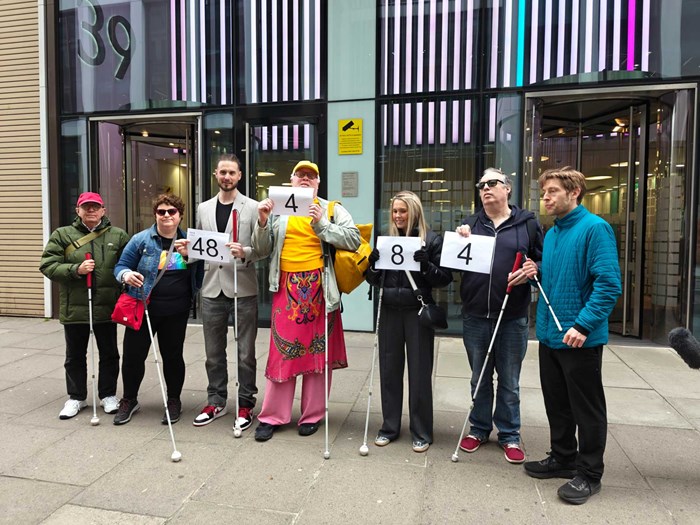
Blind disability campaigner and star of ITV’s This Morning, Claire Sisk, who lost her sight following two strokes, uses a white cane to get around. She joined today’s walk and said afterwards: “Thousands of blind and partially sighted people are having their lives put on pause waiting for vision rehabilitation. When I lost my sight, vision rehabilitation helped me learn how to use my cane (which I call Rick the Stick) and get out and about again. After receiving this support, my life changed so much, I was free; I had my independence back, I could be me again. Since then, I’ve been able to develop my career as a TV presenter and social media influencer to campaign on the issues that matter to blind people. I wouldn’t have been able to do any of this if it wasn’t for vision rehabilitation.”
Sports coach and content creator Rob Sears who has choroideremia, a genetic eye condition which means he is registered as severely sight impaired, added: “I received vision rehabilitation about four months after my diagnosis. This involved a Vision Rehabilitation Specialist coming to my house and showing me how to use a long cane for getting around. We did some sessions walking around the house, walking around the block. ,little by little building my confidence. I certainly wouldn't have had the confidence to do a lot of the stuff that I've done since without this support.”
Eleanor Thompson, Director of Policy, Campaigns and Social Action at RNIB said: “Today is an important moment in our campaign. Over the last two years we’ve been sharing people’s stories, and we’re so grateful to the 48,000 people who have backed our petition, both those personally affected and those who - like most of us - had never heard of vision rehabilitation before.
“The Health and Care Secretary can be in no doubt that it’s time to act so that every person with sight loss gets the support they need, when they need it. We know that when people don’t receive this support they often stay at home, cut themselves off from friends and family, can fall out of work or stop going about their every day lives.
“We’re here in Westminster because too many people are having their lives put on pause, unnecessarily. No one should have to wait to receive vital support after sight loss.”
RNIB’s Freedom of Information request showed that in the financial year 2023 to 2024 20 per cent of local authorities had people waiting over a year to receive just an initial assessment of the services they need; 85 per cent of local authorities did not complete vision rehabilitation assessments within RNIB’s-recommended 28 days and 38 local authorities told us assessments are not always conducted by qualified Vision Rehabilitation Specialists.
Now, RNIB is calling on the Government to develop proper guidelines and quality standards for vision rehabilitation and transform it into a regulated profession ensuring quality and consistency across the board. Find out more: https://www.rnib.org.uk/news/life-on-pause-rnib-calls-on-health-secretary-to-act/


