Cataract surgery is the most frequently performed surgical procedure in the UK [1]. With financially strained NHS trusts and the rise of independent sector cataract providers, the drive from initiatives like Get It Right First Time (GIRFT) and market pressures are pushing trainees and consultants alike towards ever higher volumes of cataract surgery.
What does this mean for the surgeon? It has several implications, but here we present an ergonomic case study of a phaco list-induced, eponymous surgical syndrome, possibly unique to the cataract surgeon.

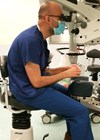
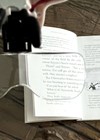
Figure 1: The offending hand position. With site of pain and compression illustrated by red lightning symbols.
Case
During a routine high-volume cataract list, a fourth year trainee is completing the fifth case on the list. As she begins the nucleus disassembly, she notices a very unusual sensation in her hand. There is a dull ache in her wrist, and she appears to be unable to feel her fourth and fifth fingers as they rest on the patient’s forehead (Figure 1). Not only this, but her hand appears to be unable to grip the phaco probe properly in a pencil grip and has a generalised sensation of poor coordination. After supressing her internal panic, she was able to complete the case slowly. Symptoms persisted after finishing the case, requiring the consultant to take over the next few cases whilst the hand recovered. Symptoms gradually improved as the day progressed.
Pub quiz
- Which nerve might be affected?
- What is the sensory distribution of this nerve?
- What is its motor function within the hand?
- Where is the lesion?
- What might be the cause?
Answers
Discussing this amongst the registrars in the doctor’s office after the list, the case brought back distant (and pungent) memories of medical school anatomy cadaver rooms discussing the anatomy of the upper limb.
The nerve affected is of course the ulnar nerve, the most medial of the three major nerves (ulnar, median and radial) supplying motor and sensory function to the hand. The ulnar nerve supplies sensation to the fifth and half of the fourth digits, and the corresponding hypothenar and dorsal regions of the hand (Figure 2).

Figure 2: The course and distribution of the ulnar nerve after it enters the volar aspect of the hand at Guyon’s canal.
Motor supply is to the adductor pollucis (thumb grip), medial interossei (finger adduction and abduction) and the hypothenar muscles (controlling the flexion, abduction and opposition of the little finger). Froment’s sign was positive in the affected individual, when tested by her enthusiastic colleagues – a weakness of the thumb and index finger pincer grip requiring over recruitment of thumb flexion.
The ulnar nerve enters the wrist via a fixed spaced known as the Ulnar Canal (or Guyon’s Canal – see Figure 2), as it passes between the carpel bones, the hook of the hamate bone, and deep to the palmar carpal ligament. It is a classic site of compression of the ulnar nerve causing the constellation of symptoms mentioned in the case above. It is more commonly experienced by long-distance cyclists due to their hand position on the handlebars, or people who spend a long time typing on a keyboard.
Discussion
High-volume cataract surgery requires the surgeon to remain in the same position, repeatedly, over an entire morning or afternoon. The importance of ensuring sustainable and comfortable ergonomics is therefore vital and, as shown in this case, can have serious immediate consequences, potentially putting patient safety at risk. Perhaps unique to cataract surgery, the procedure requires the surgeon to remain in a hand-pronated, wrist-extended and stationary position, whilst resting on the bony surfaces of the patient’s zygomatic bone or forehead. Much like long distance cyclists, this puts concentrated compression forces over the ulnar canal. Possible, specific causes may have been: over extension of the wrist, a low bed height, sitting too close to the patient, and a lack of spatial awareness to recognise these factors.
Although it is not a common occurrence, this case of a surgeon’s ulnar nerve neuropraxia acts as a reminder of the importance of good ergonomics in cataract surgery. Not only does it promote sustainable neck, back and wrist health throughout a long career as an ophthalmic surgeon, but also can have acute intraoperative consequences for the patient, who is trusting you to perform their surgery.
References
[Link last accessed June 2025]
Declaration of competing interests: None declared.