
A community optometrist examines what the high street needs before artificial intelligence (AI)-enabled systemic risk assessment moves from laboratory to consulting room.
Few areas of AI have advanced as rapidly as oculomics. Within little more than a decade, retinal imaging has evolved from an ophthalmic diagnostic tool into a potential biomarker for systemic disease. Foundation models such as RETFound have demonstrated that retinal imaging can support prediction of cardiovascular and neurodegenerative disease from retinal images [1].
A 2026 multi-omic analysis of OCT and colour fundus photographs linked retinal imaging-derived features to ischaemic heart disease, cerebrovascular disease, Parkinson’s disease and dementia [2], while deep-learning retinal biomarkers such as Reti-CVD have been validated against established cardiovascular risk calculators using UK Biobank data [3].
The concept of the retina as a non-invasive window into systemic health is no longer speculative. It is supported by a substantial and rapidly growing evidence base. These findings demonstrate the potential of retinal imaging as a source of systemic biomarkers, but they do not yet establish that oculomics can deliver an effective screening programme. That distinction matters. A promising test is not the same as a proven screening pathway, and any future oculomics programme would need to demonstrate the accuracy, clinical effectiveness, safety, acceptability and pathway feasibility expected of any screening programme [4].
This publication’s ‘AI & Oculomics’ section has covered some of these advances: prognostic AI for diabetic retinopathy [5], the retinal age gap in schizophrenia [6], NHS data infrastructure [7] and regulatory frameworks for AI as a medical device [8]. What has been largely absent, however, is the perspective of community optometry; a profession that provides a major community-based opportunity for retinal imaging, and the setting in which oculomics tools would, in many cases, need to be deployed at scale.
I write this as a community optometrist with nearly 30 years of high street practice. I sit on the DHSC ODEEN Advisory Panel and the College of Optometrists’ Policy Advisory Panel. This article is not a critique of the research – it is a call to include the deployment perspective alongside the discovery perspective, before the gap between them becomes a barrier to implementation.
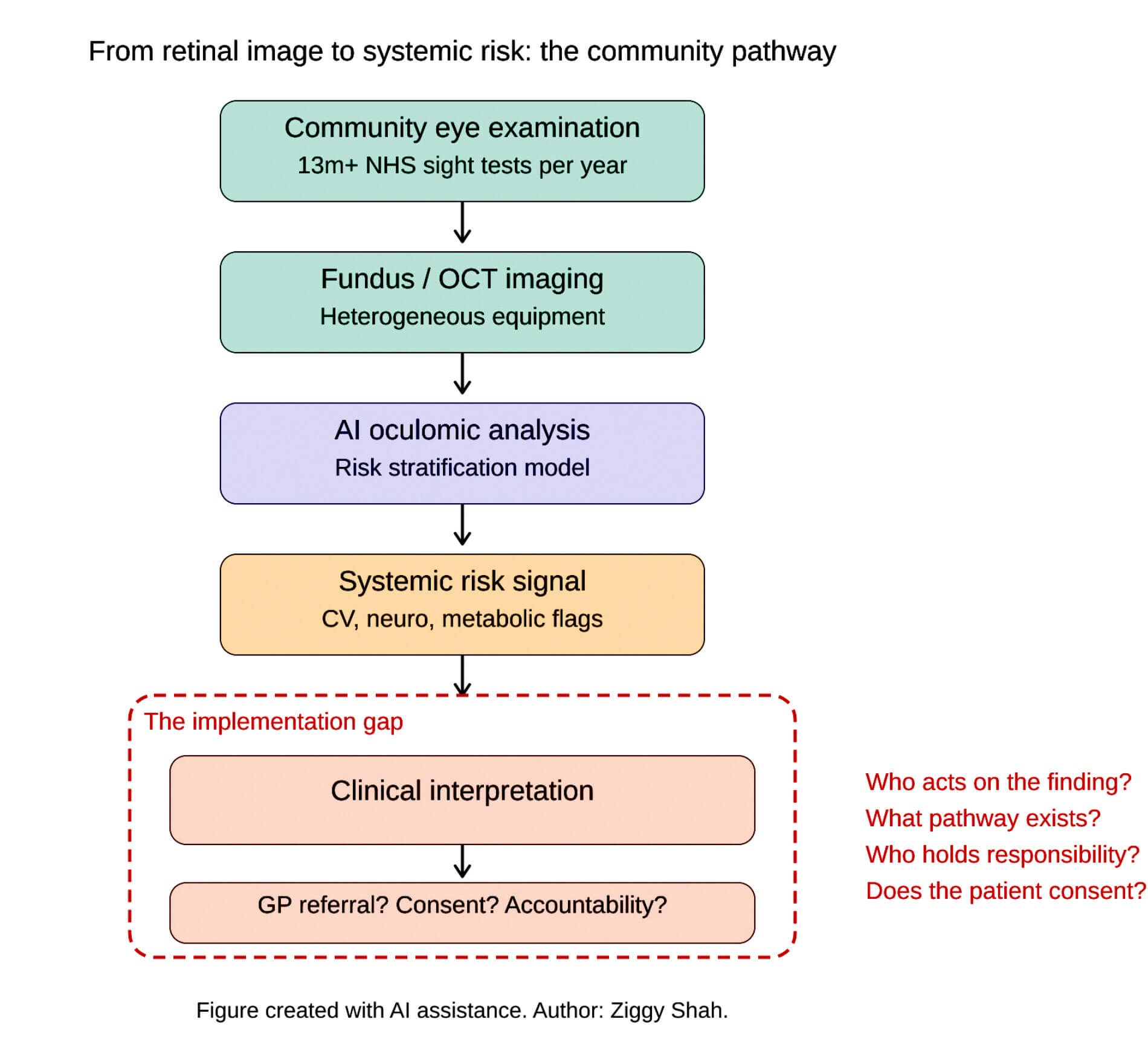
Figure 1: From retinal image to systemic risk: the community oculomics pathway, highlighting the implementation gap at the referral and clinical accountability stage. Figure created with AI assistance.
From discovery to deployment: what still needs to be proven?
Oculomics has made substantial progress through the phases of discovery and validation. The critical question now is whether, and under what conditions, deployment could be justified. Whether these tools are ultimately used for screening, risk stratification, opportunistic detection or personalised monitoring, each application will require its own evidence base and governance framework. But the operational considerations cannot wait until the evidence is complete. If they are not addressed in parallel, the gap between a validated algorithm and a deployable clinical pathway will widen.
In England alone, community optometry practices deliver over 13 million NHS sight tests annually [9]. As access to retinal imaging continues to expand across these practices, community optometry already provides one of the largest population-level opportunities to acquire retinal imaging data, and that opportunity will only grow as imaging becomes more widespread. If oculomics is to fulfil its potential, the deployment site for many applications will not be the hospital eye service – it will be the community practices where millions of patients already attend routinely and asymptomatically, at intervals that map well onto the longitudinal monitoring these algorithms require.
The prevalence problem
Artificial intelligence models trained on secondary care populations face a fundamental statistical challenge when deployed in primary care. Hospital datasets skew towards established pathology and higher baseline disease prevalence. In a low-prevalence community environment, even a highly specific algorithm will generate a higher proportion of false positive flags. This is a predictable consequence of Bayesian statistics applied to screening. Unchecked, false positives risk adding pressure to hospital services already operating under significant capacity constraints [10]. This is one reason why evidence for oculomics must extend beyond algorithmic accuracy. The UK National Screening Committee considers false positives, false reassurance, overdiagnosis and other potential harms alongside the benefits of earlier detection [4]. The clinical left-shift towards community care is well underway, but oculomics could inadvertently reverse this if referral pathways are not designed with prevalence in mind.
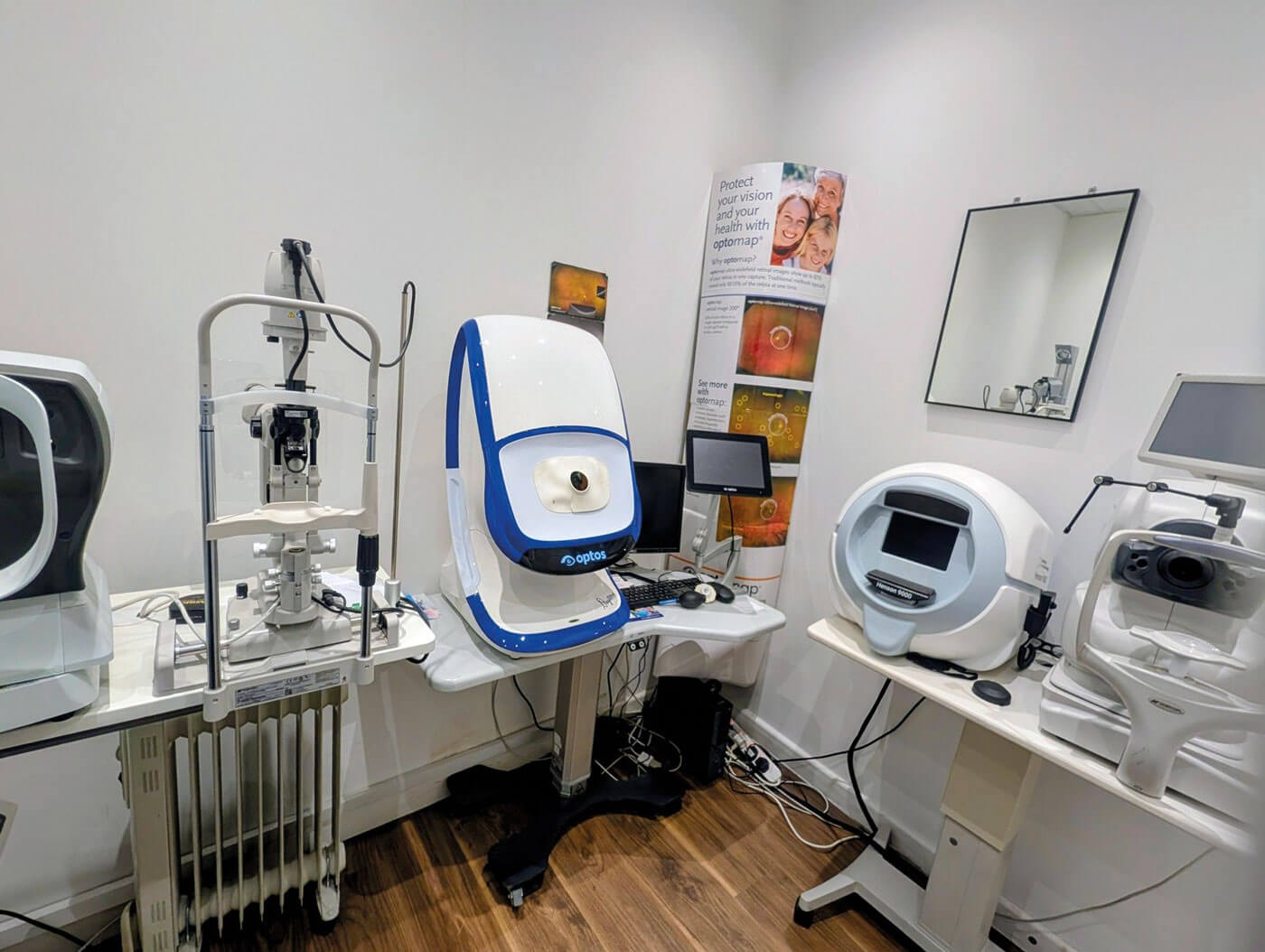
Figure 2: A typical community optometry consulting room illustrating the range of imaging equipment in daily clinical use.
Equipment heterogeneity
Community practices operate a wide range of OCT platforms, fundus camera generations and imaging protocols. One practice may use a Topcon 3D OCT, another an Optovue Avanti, and a third may rely solely on a non-mydriatic fundus camera without OCT capability. RETFound was developed predominantly using retinal imaging data from Moorfields Eye Hospital, alongside additional public datasets [1]. Even promising foundation models with demonstrated external validation still require prospective evaluation across real-world community imaging environments before deployment. In my own consulting room, OCT scan quality depends on the device, the patient’s fixation, media clarity and the time available within a busy clinic schedule. These are variables that may be under-represented or insufficiently characterised in research datasets.
The referral pathway gap
If an oculomics tool flags elevated cardiovascular risk or early neurodegeneration markers from a routine retinal scan, what happens next? Currently, there is no nationally standardised referral pathway specifically for communicating and acting on AI-derived systemic health findings from community optometry. When I identify a suspicious optic disc, I already have well-established routes for ophthalmic referral.
For systemic risk, the pathway is unclear. Who takes clinical responsibility? Does the patient consent to systemic health screening when they attend for an eye test? What constitutes an actionable finding, and what happens if the GP does not act? These questions cannot be resolved by the research community in isolation – although clinical trials will be crucial to demonstrate whether screening and new pathways benefit patients. They also require input from clinicians and patients to understand how they would like to see oculomics fit into existing healthcare systems.
Workforce readiness and clinical accountability
The College of Optometrists surveyed its membership on AI attitudes in early 2025, with headline findings suggesting broad enthusiasm [11]. Published research has explored AI attitudes among optometry students and educators [12,13]. These contributions address a general question: “How do you feel about AI?” The more specific question, “Are you prepared for the retina to become a systemic risk assessment tool, and what would you need?” remains largely unexplored.
The 2026 GOC Registrant Workforce and Perceptions Survey provides a useful indication of the wider AI-readiness context: 60% of respondents rated their AI knowledge and understanding as poor or very poor, while only 22% reported AI CPD or training in the previous 12 months. In community settings, good or very good self-rated knowledge was reported by 39% of independent and sole-practice respondents and 36% of those working in multiple settings. The most prominent concerns were AI errors (77%), legal responsibility if something goes wrong (76%) and lack of transparency (68%) [14].
As AI enters community practice, clinicians must guard against two distinct failure modes:
- Automation bias: over-relying on a negative AI output and missing subtle clinical pathology that the algorithm was not designed to detect.
- Algorithm-induced anxiety: misinterpreting low-level risk probabilities as definitive systemic disease, causing unnecessary patient distress and over-referral.
Both risks are amplified in a time-pressured community setting. Artificial intelligence should augment clinical judgement, not replace it, and community optometrists need specific training to use these tools safely and effectively.
The case for co-design
Research teams developing oculomics tools are understandably led by ophthalmologists, computer scientists and biomedical engineers. This is appropriate for the discovery phase. But as tools move towards deployment, the absence of community optometry from the co-design process becomes a strategic gap. Community optometrists bring knowledge that cannot be inferred from hospital-based data: how imaging workflows function in real-world community practice; what patients expect from an eye test; and what communication channels exist, or do not exist, between primary eyecare and general practice.
Co-design with frontline clinicians is increasingly recognised as important in digital health development and evidence generation [15]. What is new is applying it to oculomics, where the frontline clinician is a community optometrist.
The first task is not to assume that oculomics is ready for deployment, but to establish whether it can deliver meaningful health benefit safely and equitably. Algorithms alone do not screen populations. Clinicians, pathways and infrastructure do. If oculomics is to reach the patients who would benefit most, it must be developed with the active involvement of the clinicians who will deliver it. For millions of UK patients, that clinical touchpoint already exists in community optometry.
References
1. Zhou Y, Chia MA, Wagner SK, et al. A foundation model for generalizable disease detection from retinal images. Nature 2023;622(7981):156–63.
2. Julian TH, Sergouniotis PI, Keane PA, et al. Multi-omic analysis of deep learning-derived phenotypes links ophthalmic imaging to cardiovascular and neurological traits. Nat Cardiovasc Res 2026;5(6):541–54.
3. Tseng RMWW, Rim TH, Shantsila E, et al. Validation of a deep-learning-based retinal biomarker (Reti-CVD) in the prediction of cardiovascular disease: data from UK Biobank. BMC Med 2023;21(1):28.
4. www.gov.uk/government/publications/evidence
-review-criteria-national-screening-programmes
5. Jain N, Nderitu P, Jackson TL. Prognostic AI for diabetic retinopathy: towards the first prospective trial in the UK. Eye News 2026;32(5):33–4.
6. Ghadiri N, Antaki F. In conversation with Fares Antaki: the retinal age gap in schizophrenia. Eye News 2026;32(6):48–9.
7. Zelhof G, Convill J, Burgess P. Building data infrastructure for eye research in the NHS: real-world lessons from the Liverpool Eye Data Platform. Eye News 2026;33(1):35–7.
8. Ong A, Hogg J, Thirunavukarasu AJ. Regulatory approval for the use of AI as a medical device. Eye News 2025;32(3):19–20.
9. www.england.nhs.uk/primary-care/eye-health
10. www.england.nhs.uk/statistics/
statistical-work-areas/rtt-waiting-times
11. www.college-optometrists.org/news/
2025/march/shaping-the-future
-the-ai-in-eye-care-summit
12. Buckmaster F, van Staden D, Coetzee L. Attitudes and knowledge levels of optometry students and educators towards artificial intelligence in optometric practice: an online cross-sectional survey. Ophthalmic Physiol Opt 2026;46(2):419–28.
13. Buckmaster F, van Staden D, Coetzee L. Opportunities, risks and challenges integrating artificial intelligence into optometry education: A qualitative interview study. Optom Vis Sci 2026;103(6):e70077.
14. https://optical.org/static/cbd32d15-651e-4446
-b973611110032d55/GOC-Registrant-Workforce-and
-Perceptions-Survey-2026-Research-Report-final-9-July.pdf
15. www.nice.org.uk/corporate/ecd7
[All links last accessed September 2026]
Declaration of competing interests: None declared.





