The Liverpool Eye Data Platform demonstrates how governance-compliant infrastructure can bring together routinely-collected, siloed NHS eye data.
Routine care delivered across the NHS generates vast amounts of clinical data within a healthcare system that is uniquely characterised by comprehensive population coverage and integrated care pathways. Ophthalmology is particularly well-positioned to leverage this infrastructure.
High-volume outpatient activity produces structured clinical information, quantitative functional measures and repeated high-resolution imaging across national screening programmes and hospital eye services. People with common, chronic diseases such as age-related macular degeneration (AMD), diabetic retinopathy and glaucoma attend services for many years: well beyond the duration of standard clinical trials.
Recent advances in artificial intelligence (AI) and oculomics have highlighted the potential of analysing longitudinal, multimodal datasets to support risk stratification and personalised care across large patient populations. However, the difficulty of accessing eye data that is reproducible and compliant with NHS governance security frameworks remains a significant barrier. The development of robust data infrastructure is becoming a prerequisite for meaningful advances in real-world ophthalmic research.
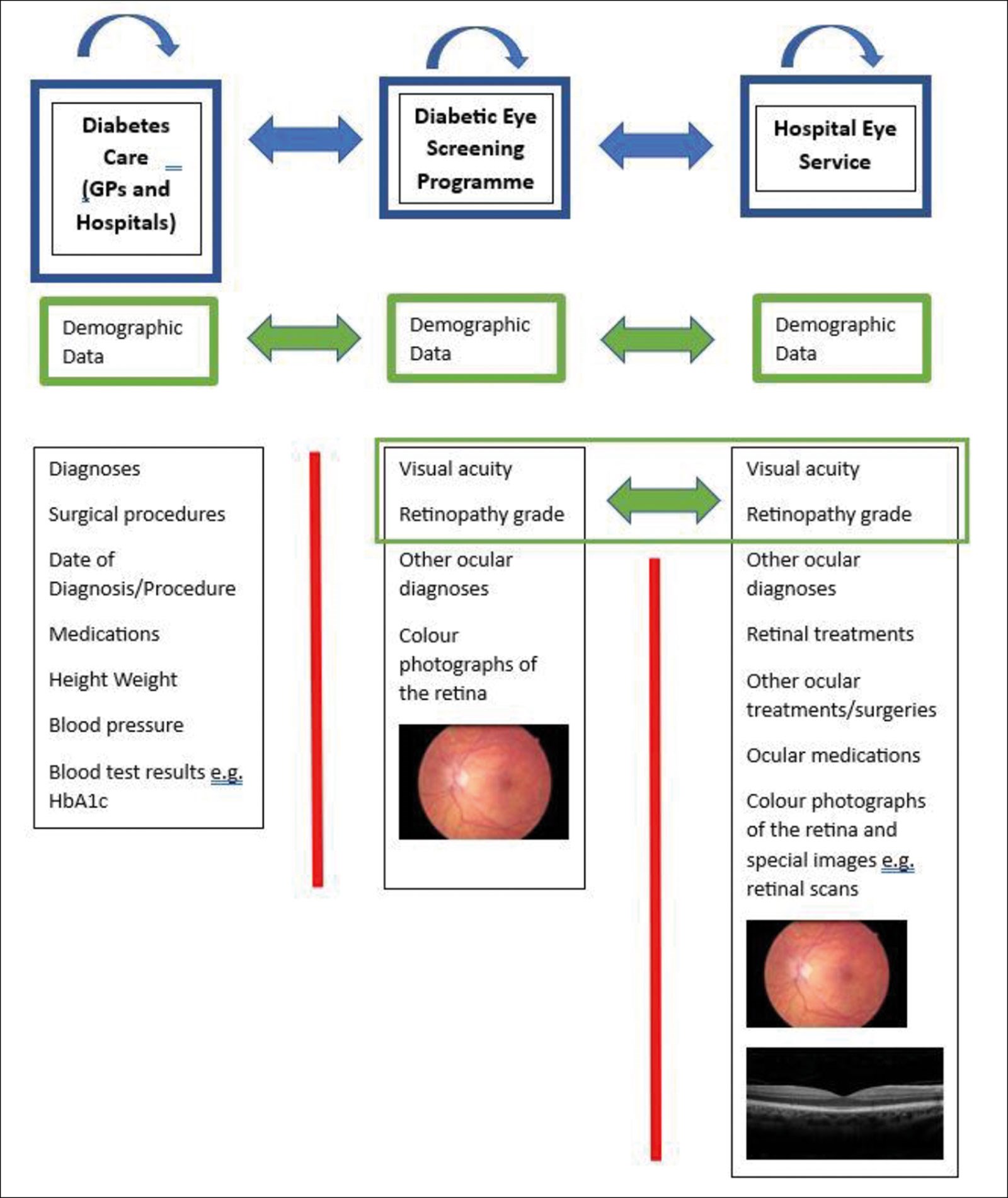
Figure 1: Fragmentation of ophthalmic data across care pathways: Routine eyecare data are generated across diabetes care, diabetic eye screening programmes and hospital eye services. Although overlapping clinical information is collected at each stage, differences in systems and data structures create barriers to longitudinal linkage across the full patient journey.
Fragmentation as a barrier to ophthalmic data reuse in the NHS
Despite the scale of data generated within eyecare, reuse for research and service evaluation remains challenging. Data are fragmented across multiple systems designed to support clinical workflows at different stages of the patient pathway, rather than provide a unified longitudinal record (Figure 1). Consequently, valuable data from screening programmes and hospital eye services remain siloed, limiting the ability to examine individual patient disease progression, referrals and treatment outcomes across datasets.
"Sustained cooperation between clinicians, data scientists, information governance and IT services has been essential to align research priorities with data protection values"
Technological advances precede the development of regulatory frameworks. Use of NHS clinical data must maintain patient confidentiality and public trust, requiring clear data controller responsibilities and robust security standards. Traditional models based on exporting project-specific datasets to individual researchers can be time-consuming and repetitive, with governance approvals and variable definitions re-established for each study. NHS policy has shifted towards secure data environments (SDEs), where approved users access data remotely within a controlled setting and only non-disclosive outputs are released [1]. This approach directly shapes how ophthalmic datasets must be designed and reused.
Introducing the Liverpool Eye Data Platform
The Liverpool Eye Data Platform (LEDP) is a joint initiative between St Pauls Eye Unit at NHS University Hospitals of Liverpool (UHL) and the University of Liverpool, developed to establish a single governed dataset and address the inefficiencies associated with project-specific extraction. The platform currently ingests clinical data and retinal images from the Liverpool Diabetic Eye Screening Programme (OptoMize software, NEC) and hospital eye services electronic patient record, Medisight (Medisoft, UK). Data feeds from imaging software packages HEYEX2 (Heidelberg) and Optos (Optos UK) are in development. The LEDP has been formally adopted as a pilot project by the North-West SDE, providing a link to primary care data as part of the regional data architecture. Preserving longitudinal structure is a core design principle, allowing patients to be followed across care settings and over time. The platform operates within a SDE hosted by local industry partner ARO Tech with access only to approved researchers behind the NHS firewall. GPU capacity is available within the SDE.
Governance and secure data environment model
A central feature of the LEDP is its governance framework. Data remain under NHS control, with UHL acting as data controller. Records of patients who have taken up the NHS National Data Opt-Out for research (6.1% of people in the North-West) are expunged prior to pseudonymisation and automated transfer into the SDE (Figure 2).
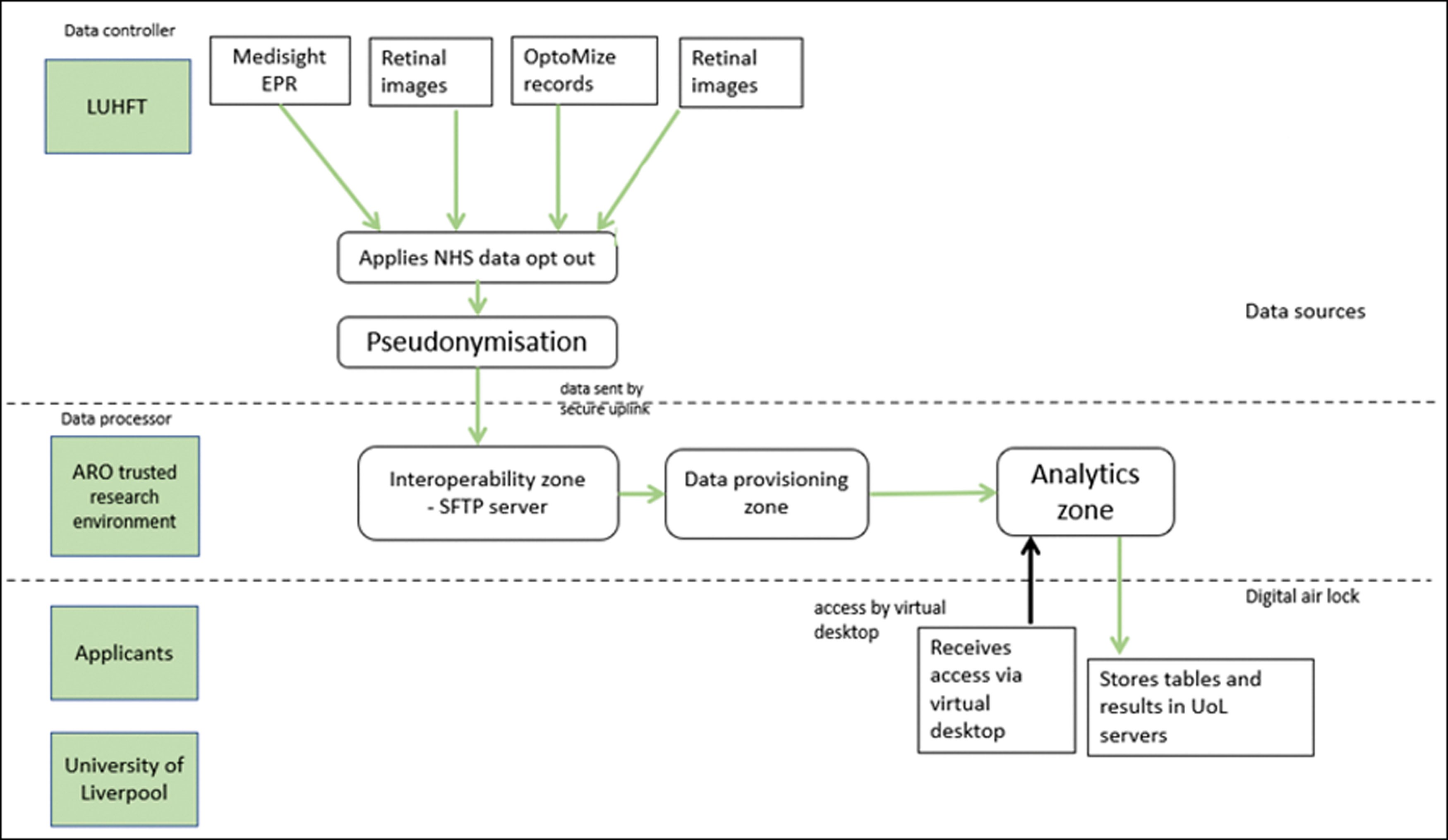
Figure 2: Secure Data Environment model of the Liverpool Eye Data Platform: Routinely collected screening and hospital eye service data remain under NHS control, with Liverpool University Hospitals NHS Foundation Trust acting as data controller. Following application of the National Data Opt-Out and pseudonymisation, data are transferred into a secure data environment, where approved users access data remotely and analyses are restricted to aggregate outputs.
Within this framework, the LEDP encompasses routinely collected screening and hospital eye service data spanning up to two decades. Screening data derived from the Liverpool Diabetic Eye Screening Programme include visual acuity, retinal photographs, diabetic retinopathy and maculopathy grades, and outcomes such as referral to tertiary services. Hospital eye service data captures diagnoses, treatments, visual outcomes and multimodal retinal imaging.
Approved users access the pseudonymised data through virtual desktops within the SDE. All analysis takes place within this environment and outputs are restricted to aggregate results, thus reducing the risk of patient re-identification and ensuring that governance controls are applied consistently across projects. While this approach introduces practical constraints compared with traditional data access, it provides a stable and auditable framework that supports repeated use of the same underlying datasets. For ophthalmology and oculomics, where research questions evolve over time, this consistency is a significant advantage.
Research in progress
The LEDP facilitates population-level analyses of approximately 90,000 individuals with diabetes who have attended retinal screening in Liverpool since 2005, with follow-up extending for up to 20 years. This scale and longitudinal coverage enable research which cannot be achieved through piecemeal real-world data extraction or clinical trials.
For the first time, researchers can study diabetic retinopathy over the whole disease course (from date of diagnosis to death) in a whole population (never before achieved for any complication of diabetes). Epidemiological data on incidence, progression and visual outcomes of diabetic eye disease will be invaluable for health service planners. The efficacy and cost-effectiveness of a broad range of interventions (including systematic screening, systemic therapies and ophthalmic treatments) can be studied over a long duration. The platform provides a foundation for predictive modelling, AI and oculomics research by enabling access to multimodal datasets derived from routine NHS care rather than curated research cohorts, improving both analytical validity and clinical relevance. Datasets for AMD and glaucoma will soon be available, with others to follow.
Researchers at the University of Liverpool are currently using the LEDP to evaluate the epidemiology and outcomes of diabetic eye disease in a defined population. Ongoing work includes analysis of up to 20 years of linked screening and hospital eye service data to describe disease prevalence, referral patterns, treatment pathways and visual outcomes, as well as investigation of screening attendance and disengagement. Additional projects are examining long-term outcomes in older patients and validating screening referrals against hospital diagnoses to improve pathway design and service delivery within the NHS.
Key lessons for eye services
The LEDP highlights several lessons that are relevant beyond a single centre. Data infrastructure should be treated as a clinical and academic asset rather than a purely technical project, with governance requirements shaping system design from the outset rather than being addressed retrospectively.
The design of the LEDP aligns with national moves towards SDEs and federated data access [1]. Sustained cooperation between clinicians, data scientists, information governance and IT services has been essential to align research priorities with data protection values. As these frameworks mature, there is increasing scope for collaboration between centres while maintaining local control of data. The INSIGHT Health Data Research Hub for Eye Health provides a further example of how ophthalmic data platforms operating within secure research environments can enable large-scale research while maintaining robust local governance and public trust [2].
Looking ahead
Advances in AI and oculomics are increasingly shaping the future of ophthalmic research and care. Realising this potential within the NHS requires the development of data infrastructure that is representative of routine practice and diverse populations and accessible within appropriate governance frameworks. The LEDP demonstrates how eye data can be brought together using existing NHS structures to support real-world research and future AI and oculomics applications. For eyecare services, investment in secure, reusable data infrastructure represents a practical step towards enabling the next generation of data-driven innovation in ophthalmology.
References
1. www.gov.uk/government/publications/
data-access-policy-update/data-access-policy-update
2. www.insight.hdrhub.org/
[All links last accessed January 2026]
Declaration of competing interests: None declared.