
New training to give eyecare professionals all the tools to provide better emotional support to patients receiving a diagnosis of sight loss was rolled out at an event in Westminster this week.
The training, developed by RNIB (Royal National Institute of Blind People) and in collaboration with the Royal College of Ophthalmologists, aims to help professionals have difficult conversations with patients as they are told about their sight loss as well as outlining routes to support services.
RNIB research found that compared to people without disabilities, blind and partially sighted people are more than twice as likely to experience unhappiness or depression.1
One research participant told the charity: “People don’t like to talk about mental health, they are quite happy to talk about your eyes, they will talk about it all day. I couldn’t even get out the house for a while, in fact I would say that in a way, the mental health side of it is even bigger than the sight loss.”
Patients say that bad experiences at the diagnosis stage can have a significant impact on their mental health and how they cope with sight loss, so handling the conversations carefully is the focus of the six training films.
The films are hosted by the Royal College of Ophthalmologists and are designed to fit around eye care professionals’ busy schedules.
The content has been developed with input from ophthalmologists, counsellors, Eye Care Liaison Officers (ECLOs) and patients, and the film features an RNIB ECLO and patients with sight loss sharing their own lived experiences.
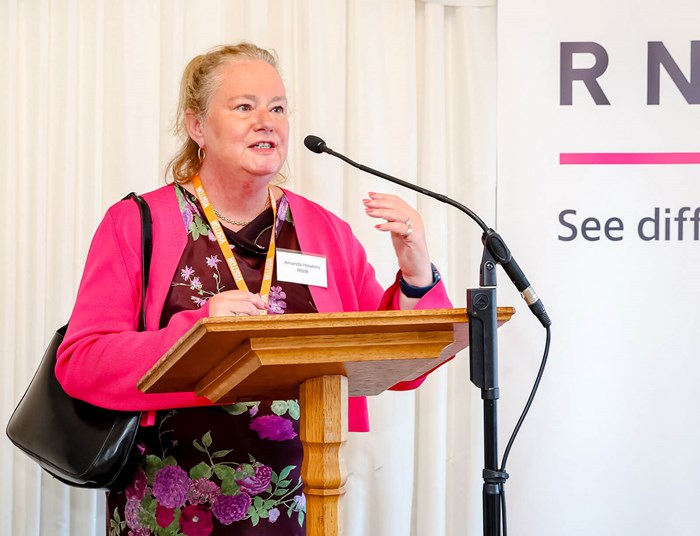
Amanda Hawkins.
Amanda Hawkins, RNIB’s Head of Mental Health and Counselling, said: “There’s a real need for training like this to help support people at a very difficult time, that moment when they first receive a sight loss diagnosis. We know good quality communication at the time of diagnoses has a significant impact on how patients process the news and cope with sight loss, and even slight changes can have a big impact.
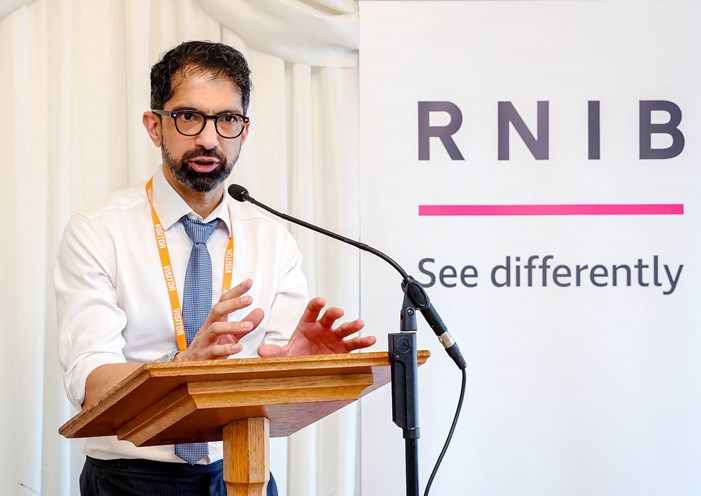
Professor Tariq Aslam.
Prof Tariq Aslem, consultant ophthalmologist at Manchester Royal Eye Hospital said he had realised through his own practice that many patients needed more support at the point of diagnosis than he first realised, and this was becoming more widely accepted in the profession. “Doctors are beginning to appreciate this is something they can do for their patients in a few minutes that can dramatically influence how that patient feels and how they walk out of their appointment.”
Alongside the training films, good practice guidelines have also been developed to help eye care professionals to embed the principles into their daily practice.
The course content also includes tools to help ophthalmologists manage their own wellbeing, recognising that delivering bad news to patients sensitively also takes a toll on the clinician.
The training modules were launched at a reception for around 50 guests held in Westminster on Wednesday, 17 June which was hosted by Marsha de Cordova MP who has nystagmus and is registered blind.
Members of RCOphth can access the training via the College’s learning platform.
References
- Stat taken from The emotional impact of sight loss, RNIB report, 2024. Voice of the customer: The emotional impact of sight loss | RNIB


