
Ahead of World Neglected Tropical Diseases (NTD) Day on 30 January, international eye care charity Orbis has announced that it has achieved the World Health Organisation (WHO) threshold for eliminating trachoma as a public health concern in Sheka Zone, Southwest Ethiopia. This means that trachoma – an excruciating eye disease that can blind people for life – is no longer a major threat to over 250,000 people living in the region.
This marks Sheka as the second zone where Orbis and partners has achieved the WHO elimination threshold, after Gedeo, a significant step forwards in efforts to eliminate trachoma, a neglected tropical disease and the world’s leading infectious cause of blindness.
Sheka Zone Reaches Major Public Health Milestone
With 66 million people at risk, Ethiopia has the world’s highest burden of trachoma. However, progress towards elimination has been significant. Worldwide, the number of people at risk has fallen from 1.5 billion to 97.1 million. For communities that have lived for generations with the risk of infection, pain and vision loss, this progress reflects lasting change – and proof that ending this disease is possible.
Dr Alemayehu Sisay, Country Director of Orbis Ethiopia, said: “Reaching the WHO trachoma elimination threshold in Sheka Zone is a major milestone for Orbis and the communities we serve. Trachoma mainly affects women and children and spreads through close contact, flies, and poor access to water and sanitation, causing pain and, in severe cases, blindness. Working with government and NGO partners, we have helped to stop the spread of infection, showing that this disease can be eliminated through sustained, community-led action.”
Bringing Sight-Saving Treatment to Communities
Orbis has worked in Ethiopia since 1998. Baseline trachoma mapping conducted in 2013-2014 through the Global Trachoma Mapping Project, funded by the UK government, identified the areas most affected. Building on this, Orbis launched a trachoma programme in 2019 with support from the END Fund, bringing sight-saving prevention and treatment across Southwest Ethiopia, and delivering surgery and mass drug administration (MDA) in partnership with Sightsavers’ Accelerate Fund.
Working alongside regional and local health authorities, Orbis has continued to deliver mass drug administration in areas where the disease remained, helping thousands of people to receive sight-saving treatment and contributing to a continual decline of trachoma rates across the region.
Andrew Wardle, Institutions and Networking Lead at Orbis UK, said: “Through collaboration with local health authorities, partners and supporters, trachoma has been brought under control in Sheka Zone, demonstrating that with the right support, this disease can be eliminated as a public health problem for good.”
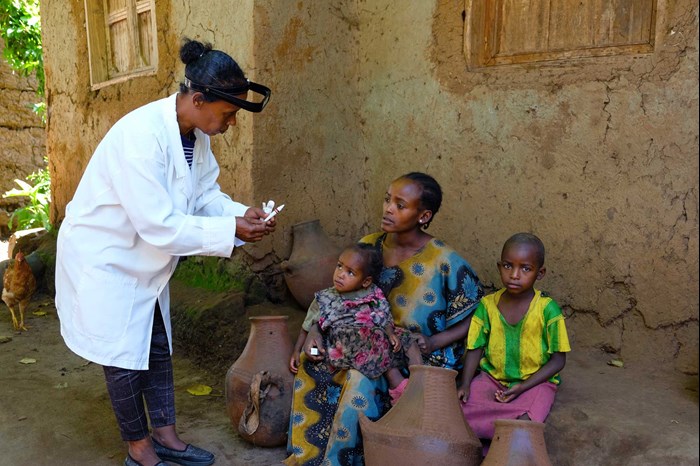
Selamimesh, and her children Lidya and Meaza, receive treatment for trachoma infection.
Trachoma Elimination
Trachoma is one of the world’s oldest infectious diseases, with evidence found in human skeletons dating back more than 8,000 years. Repeated infections cause the eyelashes to turn inwards and scrape against the eye, leading to intense pain, scarring and, if left untreated, irreversible blindness.
Although trachoma is preventable and treatable through antibiotics, surgery and sanitation, more people are at risk from trachoma in Ethiopia than any other country. Access to high-quality, affordable eye care remains limited, particularly in rural areas, due to a lack of resource, training, and infrastructure. Eliminating the disease protects children from lifelong vision loss and frees communities from a cycle of pain and impoverishment.
Since the project began, Orbis and its partners have delivered more than half a million doses of antibiotics across Sheka Zone to stop trachoma from spreading. The charity has also carried out over 600 surgeries to prevent further pain and sight loss in people already affected. Alongside education on hygiene and sanitation, this work has helped protect communities and reduce the risk of future cases.
What comes next
While trachoma elimination in Sheka Zone marks a major success, significant eye care needs remain. Orbis is now building on this progress through a new project in Southwest Ethiopia that will, for the first time, bring consistent secondary eye care to communities across six zones and 50 districts, reaching a population of more than 3.3 million people.
The project will establish and strengthen Secondary Eye Care Units, train local eye care professionals, improve the quality of cataract surgery and refraction services, and expand outreach to communities most at risk of being left behind. By strengthening local services and leadership, the project will help to ensure that the gains made through trachoma elimination are protected and that more people can access the eye care they need, closer to home.
Sheka Zone’s success proves that progress is possible, but millions of people are still at risk of avoidable sight loss.
To find out more about Orbis’s work in Ethiopia, and to donate, visit Orbis | Eye Charity | Fighting Global Blindness | Orbis UK


