
CBM Ireland has urged Governments to make clear, funded commitments on global eye health ahead of a pivotal international summit later this year, warning that avoidable blindness persists not for lack of solutions, but for lack of political and financial action.
The call comes with the publication of a new report, “Eye Health: a development accelerator rather than a narrow clinical concern”, which sets out a roadmap for delivering equitable eye care worldwide in the aftermath of CBM Ireland’s ‘A Global Lens on Eyecare’ conference held in Dublin on April 21st this year.
The report highlights that at least one billion people worldwide live with preventable or untreated vision impairment, with the burden falling overwhelmingly on low- and middle-income countries.
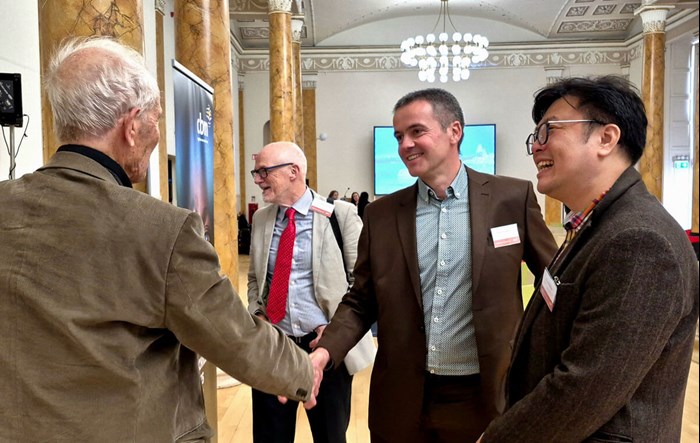
Dualta greets John, MBE.
From global commitment to delivery
Ireland was a co-sponsor of the 2021 UN resolution “Vision for Everyone”, committing the international community to expanding access to eye care. CBM Ireland argues that the forthcoming Global Summit for Eye Health in November 2026 represents a critical opportunity for Ireland to recommit to eye health and bring other donor governments with them.
Dualta Roughneen, CEO of CBM Ireland, said: “There is now a clear gap between global commitments and delivery. Ireland has already shown leadership at the UN level; the challenge now is to translate that into concrete measures that will expand access to eye care at scale.”
The organisation is calling on Governments to:
- Commit multi-year, predictable funding for integrated eye care within development programmes
- Embed eye health within Ireland’s support for universal health coverage
- Invest in primary and community-based delivery models
- Support the scale-up of high-impact interventions such as infant eye-screening using affordable technology
- Back appropriate technology and digital innovation to extend reach in low-resource settings
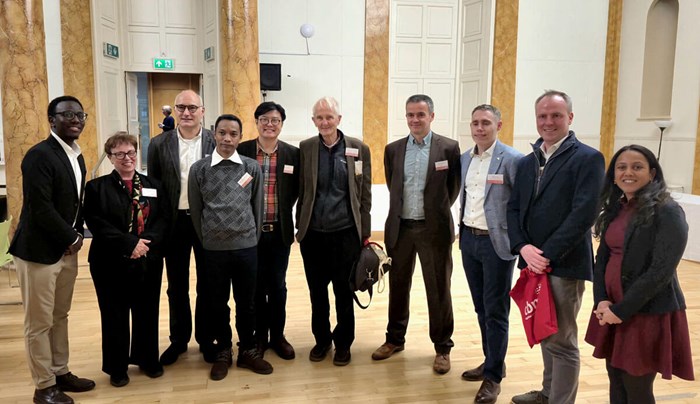
A systemic, not technical, failure
The report’s central conclusion is that avoidable blindness should now be understood as a systemic and political failure, rather than a medical one.
While effective and affordable interventions are well established, their delivery remains uneven. The paper points to gaps in financing, workforce development, governance, and community engagement as the barriers to progress.
“The tools to eliminate avoidable blindness already exist,” Roughneen said. “What is missing is the alignment of political will, financing, and health systems to deliver them to those who need them most.”
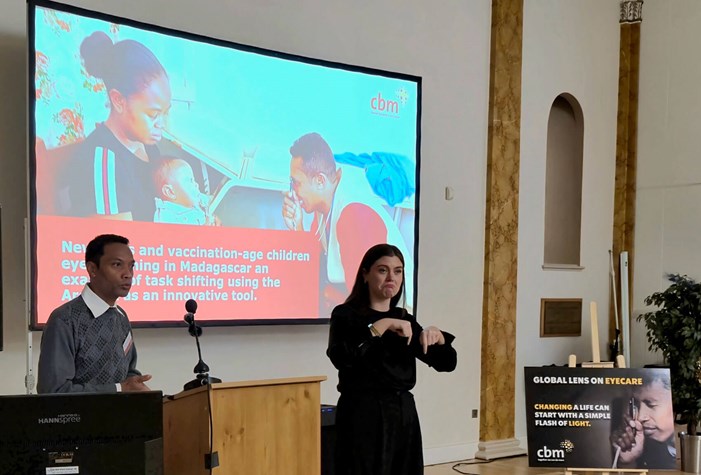
Jaona presenting.
Economic and development implications
The report situates eye health firmly within the broader development agenda, noting that vision underpins education, labour participation, and economic productivity. It highlights that avoidable vision impairment costs the global economy in the region of €400 billion annually, while investment in eye care delivers substantial returns. As such, CBM Ireland argues that eye health should be recognised as a development accelerator, contributing directly to progress across multiple Sustainable Development Goals.
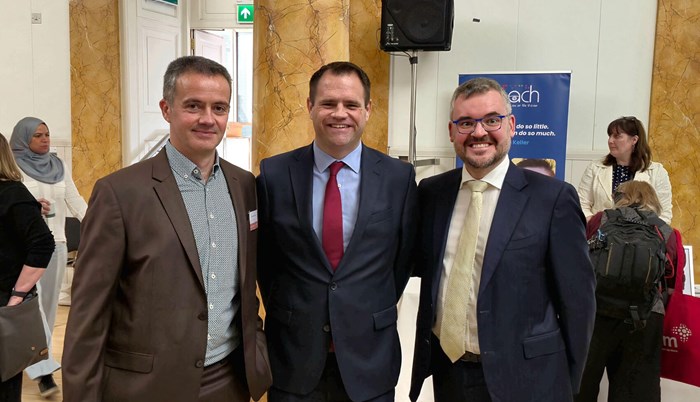
Dualta, Neale, Mark.
From innovation to integrated systems
Drawing on international evidence and case studies, the report emphasises that future progress will depend on integrating eye care into primary health systems and universal health coverage frameworks.
Key priorities identified include:
- Scaling primary eye care at community level
- Expanding workforce capacity through task-sharing and training
- Leveraging low-cost technologies and AI-enabled diagnostics
- Strengthening accountability and national ownership of programmes
These approaches are already demonstrating impact, including large-scale screening initiatives in Madagascar and the use of low-cost diagnostic tools such as the Arclight device.
With the Global Summit approaching, CBM Ireland warns that the international community must move beyond general commitments toward specific, measurable and funded actions.
Dualta Roughneen added: “Avoidable blindness persists not because we lack solutions, but because those solutions are not reaching people at scale. With the Global Summit approaching, countries like Ireland have a clear opportunity — and responsibility — to step forward with meaningful commitments that will help close that gap.”


