
Charity leaders, politicians, tech innovators and a national treasure unite at Vis-Ability 2026 to shape a more inclusive future for people living with sight loss
Senior figures from government, business, healthcare and technology joined blind and vision impaired leaders at Vis-Ability 2026 in Westminster yesterday (10th June) to explore how innovation, employment and healthcare can become more inclusive for people living with sight loss.
Hosted by national charity Fight for Sight, the conference brought together over 100 delegates committed to breaking down barriers and creating opportunities for blind and partially sighted people across the UK.
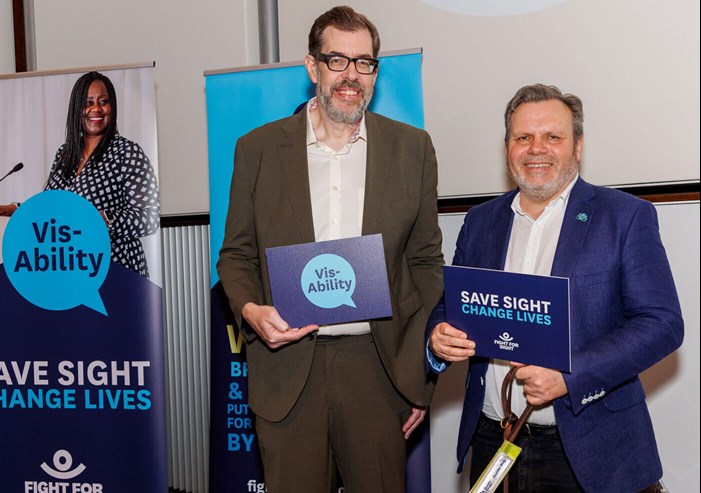
Richard Osman with Fight for Sight CEO Keith Valentine at Vis-Ability 2026.
Vis-Ability 2026 was created to tackle these challenges head-on, bringing together people who want to connect, contribute and drive meaningful change. With headline sponsor HSBC, and panel sponsors Roche Products Ltd* and Be My Eyes, participants shared experiences, explored practical solutions and took part in conversations designed to influence policy, practice and future opportunities.
Among those sharing their lived experience with delegates was author, broadcaster and presenter Richard Osman, who spoke candidly about living with nystagmus. He said: "It was a privilege to take part in Vis-Ability 2026, as we don't talk nearly enough, openly enough, about living with a vision impairment. The more candid we are, the more barriers we break down and the more confidence we give others to aim high, dream big and do extraordinary things.
“If we want a more inclusive world for blind and vision impaired people, it starts with listening, learning and taking action. That's exactly why conferences like this matter and I was pleased to contribute to those conversations."
Fellow keynote speaker The Secretary of State for Work and Pensions, Pat McFadden, shone a light on disability employment levels: “One in four, of people with severe sight loss, aren't working. That is about a third of the rate of the rest of the population of as a whole. It's about half the disability employment level as a whole, so we really have a lot to do.
“One thing to say is that it's a mark of a civilised society that for people who need support from the system it should be there. It's an important contention and security role of the welfare system and it must be there for those with lifelong conditions.”
After his speech, in a Q&A on stage with Fight for Sight’s CEO Keith Valentine, Pat talked about the “power of technology” to enable people with disabilities to “have more full participation in society”. He said: “What I think is really important is we can have a beneficial dialogue between disabled people's organisations and the big tech companies developing this technology and I think it can have real benefits from it.”
Other influential participants included technology innovators Hector Minto, Christopher Patnoe and Sumaira Latif; leading clinicians Dr Lola Solebo and Dr Josef Huemer; practising NHS optometrist and MP Shockat Adam; charity leader Neil Heslop OBE; and disability advocate, business leader and internationally recognised visually impaired tennis player Naqi Rizvi.
Vis-Ability 2026 was chaired by Fight for Sight Chief Executive Keith Valentine, who said: “Vis-Ability was founded on a simple belief: accessibility and inclusion should not sit on the sidelines of innovation, employment or public life. They should be central to it. As we often say, true inclusion happens when accessibility is designed in from the beginning, not added as an afterthought.
“Our hope is that this conference continues to drive practical change, challenge assumptions and create opportunities for greater inclusion across society.”
Throughout the afternoon, delegates explored three critical themes shaping the future of eye health, accessibility and opportunity in the UK:
- Technology – designing AI and emerging tools for inclusion
- Employment – creating equitable workplaces and unlocking talent
- Health – transforming eye care through innovation and the Life Sciences Sector plan
Vis-Ability 2026 demonstrated the power of bringing together policymakers, employers, researchers, technology leaders and people with lived experience to create a more accessible and inclusive future for everyone.
For more information about Vis-Ability 26: https://www.fightforsight.org.uk/get-involved/vis-ability-2026/


