
Climate change is among the most urgent global health threats. In 2016, environmental factors caused 13.7 million deaths worldwide, underscoring the link between planetary and human health [1]. Healthcare itself is not blameless. Globally, the sector accounts for 4.4% of net carbon emissions, with operating rooms among the highest contributors [2]. Cataract surgery – the most commonly performed surgical procedure worldwide – offers a compelling case study for examining this intersection of patient care and environmental responsibility.
The global footprint of cataract surgery
In high-income countries, cataract surgery is highly resource intensive. One UK phacoemulsification produces about 180kg of CO2e – roughly equal to driving 500km [3]. Much of this comes from single-use consumables. In the US, healthcare accounts for 10% of greenhouse gas emissions and 9% of air pollutants [4]. When multiplied across the 28 million cataract surgeries performed globally each year [5], the environmental cost becomes staggering.
The Aravind model
By contrast, the Aravind Eye Care System in southern India demonstrates that sustainability can go hand in hand with high-volume, high-quality care. An environmental lifecycle assessment at Aravind found that cataract surgery generated just 250g of solid waste equivalent to 5.9kg of CO2e per case [6]. This is roughly 5% of the UK’s footprint, achieved without compromising outcomes. Indeed, Aravind’s postoperative endophthalmitis rates are lower than those reported in the American Academy of Ophthalmology registry: 0.01% versus 0.04% [7].
How is this achieved? The model depends on careful reuse of instruments and supplies under strict sterilisation. Even phaco tips, tubing, gowns and eyedrop bottles serve multiple patients safely. Bedsheets are laundered, not discarded. Outcomes are meticulously tracked to ensure safety. Combined with an assembly-line approach, Aravind delivers world-class results at a fraction of the cost and waste.

Rooftop and land solar panels of Aravind Eye Hospital.
Barriers in high-income settings
If such practices are safe and effective, why are they not widely adopted elsewhere? A survey of more than 1300 cataract surgeons and nurses revealed that 93% felt operating room waste was excessive, and 78% supported reusable supplies [8]. Yet regulatory restrictions and manufacturer policies remain major barriers. Many countries mandate single-use consumables without clear safety evidence, driven by liability concerns and commercial incentives favouring disposables.
The Covid-19 pandemic inadvertently created a natural experiment. When Aravind briefly adopted Western-style protocols driven by precautions for Covid – changing gloves and gowns for each case, one patient per room – infection outcomes did not improve [7]. This finding raises important questions about whether some widely accepted practices are evidence based and unnecessarily wasteful.

Educating patient relatives on sustainability approaches.
Sustainability beyond the operating room
Surgical supplies are only part of the picture. Hospitals themselves consume enormous energy and water resources. Aravind has introduced environmentally conscious practices across its network, such as energy-efficient building design, solar power and organic wastewater recycling. One large hospital now recycles over 90% of its water [5]. Energy audits show that efficient lighting, ventilation and equipment can cut power use by 10%, while green energy lowers emissions and costs further [5].
Lean clinical protocols also help reduce waste and resource use. For instance, minimising patient visits for investigations or cross-consultations, reduces travel-related emissions, an often-overlooked component of healthcare’s footprint. Collectively, these measures demonstrate that sustainability can be embedded into the entire care pathway.
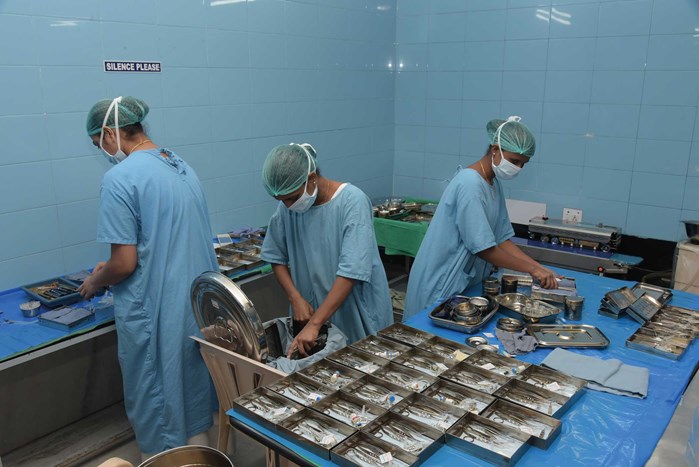
Instruments prepared for sterilisation and reuse.
Innovation and future directions
Technology can further advance sustainability. A recent study at Aravind evaluated an offline artificial intelligence (AI) tool for detecting diabetic retinopathy at rural vision centres [9]. Accurate onsite screening reduced referrals and travel, improving care while cutting emissions. AI-enabled teleophthalmology may thus represent a greener, more equitable model of care.
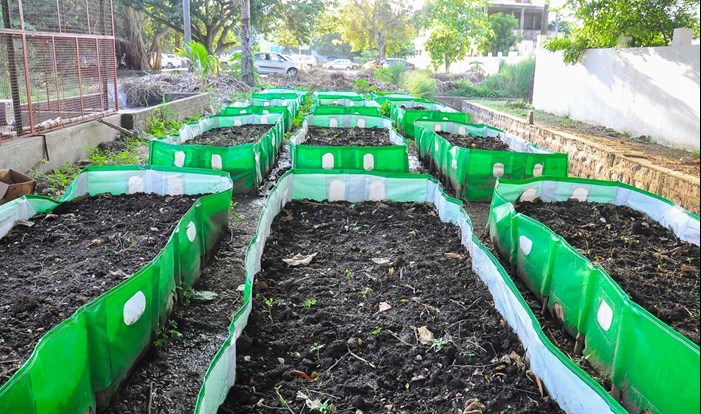
Vermicomposting food and plant waste.
Conclusion
Cataract surgery illustrates the tension between maintaining safety, ensuring access and protecting the environment. India’s experience shows surgery’s carbon footprint can drop sharply while maintaining – even improving – outcomes. For the global ophthalmology community, the challenge is to question entrenched practices, push for evidence-based regulation and advocate for sustainable innovation. If we succeed, cataract surgery can continue to restore sight at scale without costing the Earth.
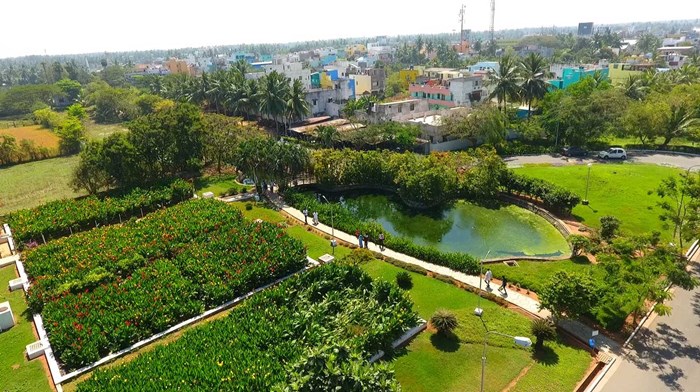
Organic wastewater treatment process.
References
- https://www.who.int/publications/i/item/9789241565196
- https://global.noharm.org/focus/climate/health-care-climate-footprint-report
- Morris DS, Wright T, Somner JEA, Connor A. The carbon footprint of cataract surgery. Eye (Lond) 2013;27(4):495–501.
- Eckelman MJ, Sherman J. Environmental impacts of the U.S. health care system and effects on public health. PLoS One 2016;11(6):e0157014.
- Ravilla T, Rengaraj V, Balakrishnan N, Ravilla S. Eye care and the carbon footprint. IHOPE J Ophthalmol 2022;1(2):25–31.
- Thiel CL, Schehlein E, Ravilla T, et al. Cataract surgery and environmental sustainability: waste and lifecycle assessment of phacoemulsification at a private healthcare facility. J Cataract Refract Surg 2017;43(11):1391–8.
- Haripriya A, Ravindran RD, Robin AL, et al. Changing operating room practices: the effect on postoperative endophthalmitis rates following cataract surgery. Br J Ophthalmol 2022;106(10):1360–5.
- Chang DF, Thiel CL, et al. Survey of cataract surgeons’ and nurses’ attitudes toward operating room waste. J Cataract Refract Surg 2020;46(7):933–40.
- Upadhyaya S, Rao DP, Kavitha S, et al. Diagnostic performance of the offline Medios artificial intelligence for glaucoma detection in a rural tele-ophthalmology setting. Ophthalmol Glaucoma 2024;7(5):1–9.
[All links last accessed December 2025]



