
A single cataract procedure in the UK has been estimated to have a carbon footprint equivalent to driving a typical non-electric car for 310 miles. Surprisingly, very few centres around the world have worked out the environmental cost of cataract surgery and there appears to be a wide variation amongst those few, largely due to the differences in their service models. The GIRFT (Getting It Right First Time) study in England has indicated that following GIRFT best practice pathways for cataract surgery could lead to saving 17.5 kilotons CO2e/year, enough to power 15,887 average UK homes with electricity.
Sustainability Index for Disposables in Cataract Surgery (SIDICS) is an excellent ESCRS-led initiative to help surgeons evaluate the sustainability of cataract packs. It offers an easy-to-use tool, whereby after inputting the quantities of items in the surgical pack, it generates a carbon emissions value calculated from the quantities entered. This is then compared against the ESCRS benchmark, instantly identifying the saving potential. The recommendations for optimisation of the surgical pack are also clearly laid out for the benefit of the user.
An update on fluorinated gases used in vitreoretinal surgery
Vitreoretinal surgery uses three of the seven gases / groups identified by the Kyoto protocol as greenhouse gases [1]. Greenhouse gases have a global warming potential (GWP), which is a measure of how much energy the emissions of one tonne of a gas will absorb over a given period, relative to the emissions of one tonne of CO2. In other words, GWP compares the heat-trapping ability of different greenhouse gases relative to that of CO2. It also considers the duration for which the gas remains active in the atmosphere. A higher GWP means that a gas will warm the Earth more than an equal mass of CO2 over the chosen time horizon (which is usually quoted for 100 years – GWP100). Here is a table that shows the GWP data:
|
Compound |
Global Warming Potential (GWP100) |
Atmospheric lifetime (years) |
|
Carbon dioxide (CO2) |
1 |
50–100 |
|
Sulphur Hexafluoride (SF6) |
24,300 |
3200 |
|
Hexfluoroethane (C2F6) |
12,200 |
10,000 |
|
Octafluoropropane (C3F8) |
8900 |
2600 |
This means that one tonne of SF6 can cause 24,300 times as much warming as one tonne of CO2. The data drives home the point that even small quantities of these sight-saving gases can have a significant environmental impact.
So, what is being done about it?
A multi-centre study in the UK, found that significant variations exist in fluorinated gas use and carbon emissions between different vitreoretinal centres [2]. While retinal detachment and macular hole surgeries formed the highest indications for usage across centres, the usage of gases, for example SF6, varied for retinal detachment repair, between 21.4% in one centre to 55.3% in another. The following are possible alternatives to fluorinated gases
- Air tamponade: Using air as a tamponade in selected cases of rhegmatogenous retinal detachment can offer comparable outcomes in suitable cases. Studies have shown substantial reductions in CO2emissions in such centres.
- Smaller canisters: The use of smaller, single-use or multi-use canisters (e.g. 30ml) instead of large cylinders can markedly decrease carbon emissions by reducing gas wastage.
- Lower concentrations: Research is exploring the use of lower concentrations of fluorinated gases, such as 8% C2F6as an alternative to SF6 for short-duration tamponade, to lessen the environmental impact while maintaining surgical efficacy. This specific concentration of C2F6 has been observed to have a mean disappearance time of about 27.6 days.
Achieving the balance towards net-zero
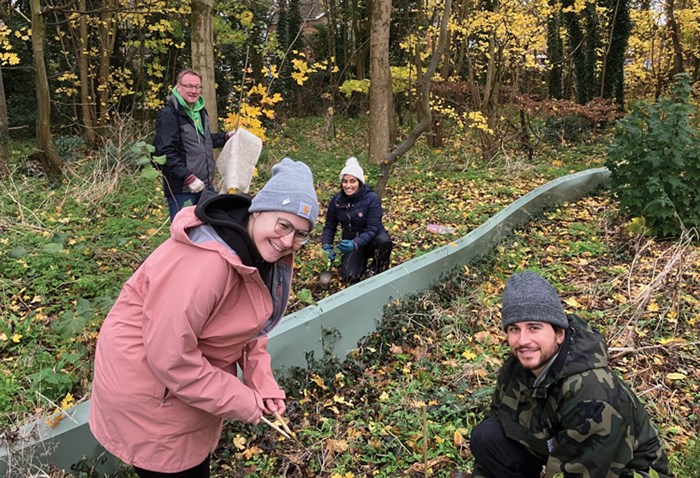
Achieving net zero involves initiatives to offset our carbon emissions and within our department at North West Anglia NHS Trust, we have chosen, amongst other initiatives, to increase tree cover. Trees naturally sequester carbon dioxide from the atmosphere and hence reduce the concentration of greenhouse gases. In addition, trees support biodiversity, improve air quality and stabilise the soil. The UK tree cover is currently 13% and the Climate Change Committee has recommended that it go up to at least 17% by 2050.
We have contributed to that effort in a small way by planting trees in a patch of Peterborough City Hospital NHS estate on 1 December 2024. The staff of the eye department were engaged in this planting event and have called it the ‘Eye Patch’. The initiative is hoped to raise awareness of the need for action to avert a climate emergency and inspire our colleagues within the health service and the wider population. NHS Forest (nhsforest.org) supplied the trees that were used in our planting for free.
References
- https://treaties.un.org/doc/Publication/CN/2012/CN.718.2012-Eng.pdf
- Moussa G, Ch’ng SW, Ziaei H, et al. The use of fluorinated gases and quantification of carbon emission for common vitreoretinal procedures. Eye (Lond) 2023;37(7):1405–9.



