
- Sponsored Content -
As demand rises and patients ask more of their vision after surgery, cataract innovation is being pushed at different points along the pathway - from more differentiated lens choices and expectation-setting before surgery to control, workflow and efficiency in the operating room.
Cataract surgery is performed at such scale that the numbers can be easy to overlook. It remains the most performed operation in the NHS, with more than 680,000 procedures undertaken annually in England alone, according to the Royal College of Ophthalmologists.1 Behind that number is a service under continuing pressure: an ageing population, high surgical volumes and patients who increasingly arrive with a clear idea of what they want their vision to allow them to do afterwards.
That raises the bar for innovation. In a high-volume procedure with well-established techniques, 'new' is not enough. What matters is identifying where there is a meaningful boundary to push - whether in the visual choices available to patients or in the practical experience of surgeons and theatre teams.
Those needs emerge at different points in the same cataract pathway. Before surgery, the conversation centres on the patient's eye, daily life and expectations. In theatre, the priorities shift to energy delivery, fluidics, stability, control and workflow. Clareon® PanOptix® Pro and UNITY® Cataract System (CS) illustrate two different ways Alcon is approaching that challenge: refining an established IOL category through optical engineering and redesigning surgical performance around superior efficiency.##, 2-5.
A higher bar for change
For Olga Kostetskaya, country franchise head, UK & IE, who works closely with Alcon's UK customers, the bar for adopting new technology is understandably high. Cataract services already have established pathways, trained teams and familiar technologies. Changing any part of that set-up has to be worth the disruption.

Olga Kostetskaya, country franchise head, UK & IE.
“What we hear from UK teams is that innovation has to solve a recognisable problem,” Kostetskaya says. “Surgeons want confidence in the clinical evidence and in how a technology will perform within their workflow. They are asking very practical questions: what does this add for my patients, how does it fit the way my team works, and is the difference meaningful enough to change what we do today?”
On the patient side, expectations are multiple and growing. Distance vision is only part of the picture. Reading a message, working at a screen, seeing a dashboard, driving after dark or reducing reliance on glasses can all carry different weight for different people. As IOL categories become more differentiated, the opportunity is not simply to add more choice, but to extend what each category can offer - giving surgeons more relevant options for different patient needs and supporting a clearer pre-operative conversation about the patient's visual priorities.
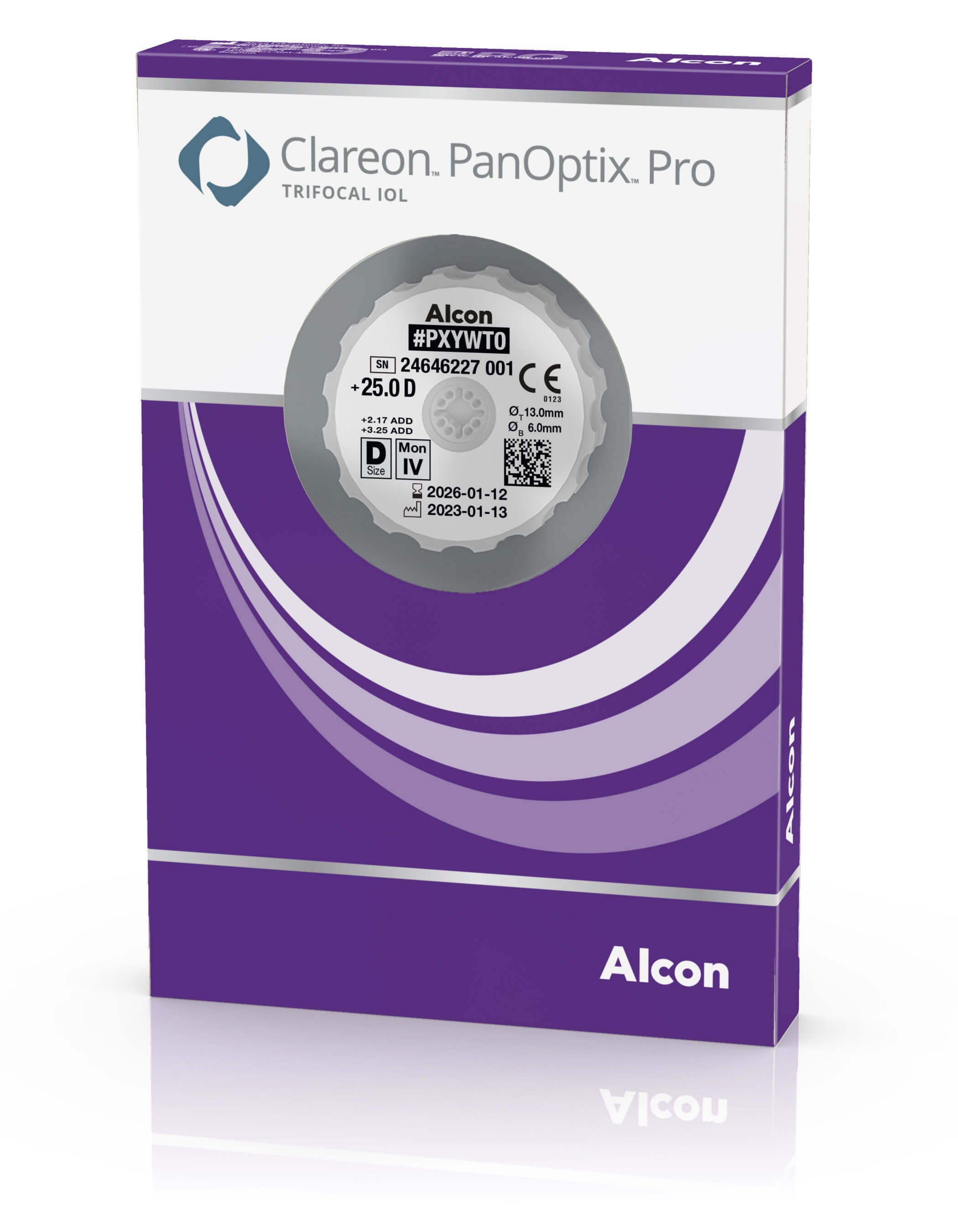
Clareon® PanOptix® Pro.
PanOptix Pro is one example of that approach. Rather than introducing a completely new trifocal concept, it builds on the Clareon platform and the established Clareon PanOptix clinical profile while advancing how light is managed across the full visual range. Its ENLIGHTEN™ NXT Optical Technology is designed for uninterrupted light distribution across the full visual range* and better image contrast.**6 In bench and vision-simulator testing, Clareon PanOptix Pro demonstrated a 50% reduction in light scatter compared with Clareon PanOptix,§, 6, 7 by increasing light utilisation to 94%.§, 6, 7.
Victor Duran, VP Surgical International Marketing at Alcon, describes this development as a purposeful evolution rather than reinvention.

Victor Duran, VP Surgical International Marketing.
“PanOptix was already a platform trusted by surgeons and patients for its proven clinical outcomes so the question for the R&D team was not, ‘How do we make it different?’ It was, ‘Where is there still room to improve something that matters more?’” Duran says. “Light management was one of those areas. The aim was to recover more of the light that would otherwise be scattered and put it to useful work, while building on the underlying PanOptix design.”
More choice, more conversation
As the IOL landscape expands, lens selection becomes less about choosing from a short menu and more about understanding the balance an individual patient is looking for. The broader Clareon Collection spans different optical categories, giving surgeons options designed around different visual objectives rather than asking one lens technology to meet every need.
That principle is visible in Alcon's latest IOL introductions at ESCRS. PanOptix Pro features an optimized optical design enabled by next-generation ENLIGHTEN NXT Optical Technology6, while Clareon TruPlus - launched in the US and now in European markets at the congress - is a new enhanced monofocal IOL designed to deliver more intermediate visual acuity than Clareon, without compromising distance or quality of vision you expect from a Monofocal.8-10 These technologies address different patient objectives, but both reflect an effort to push performance boundary within their respective categories and give surgeons differentiated options for individual visual needs.
“The conversation has moved on from simply asking whether the cataract can be removed successfully,” Kostetskaya says. “Patient expectations are growing, and people are looking for solutions that reflect their lifestyle needs and priorities. That makes expectation-setting much more important. Having more IOL options is valuable, but it also means being very clear about what matters to the individual patient and what each option is designed to do.”
When the priorities shift to the operating room
Once the patient reaches theatre, the priorities change. The lens choice has been made; the focus turns to performing a precise procedure in an environment where small sources of friction - set-up, equipment interaction, fluidics, stability and transitions between steps - can accumulate across a busy list.
Here, the innovation question is different. For hospitals and surgical teams, performance is only part of the decision. A new system also has to fit established workflows, training requirements and the practical realities of a busy theatre - all of which shape how readily new technology can be adopted.
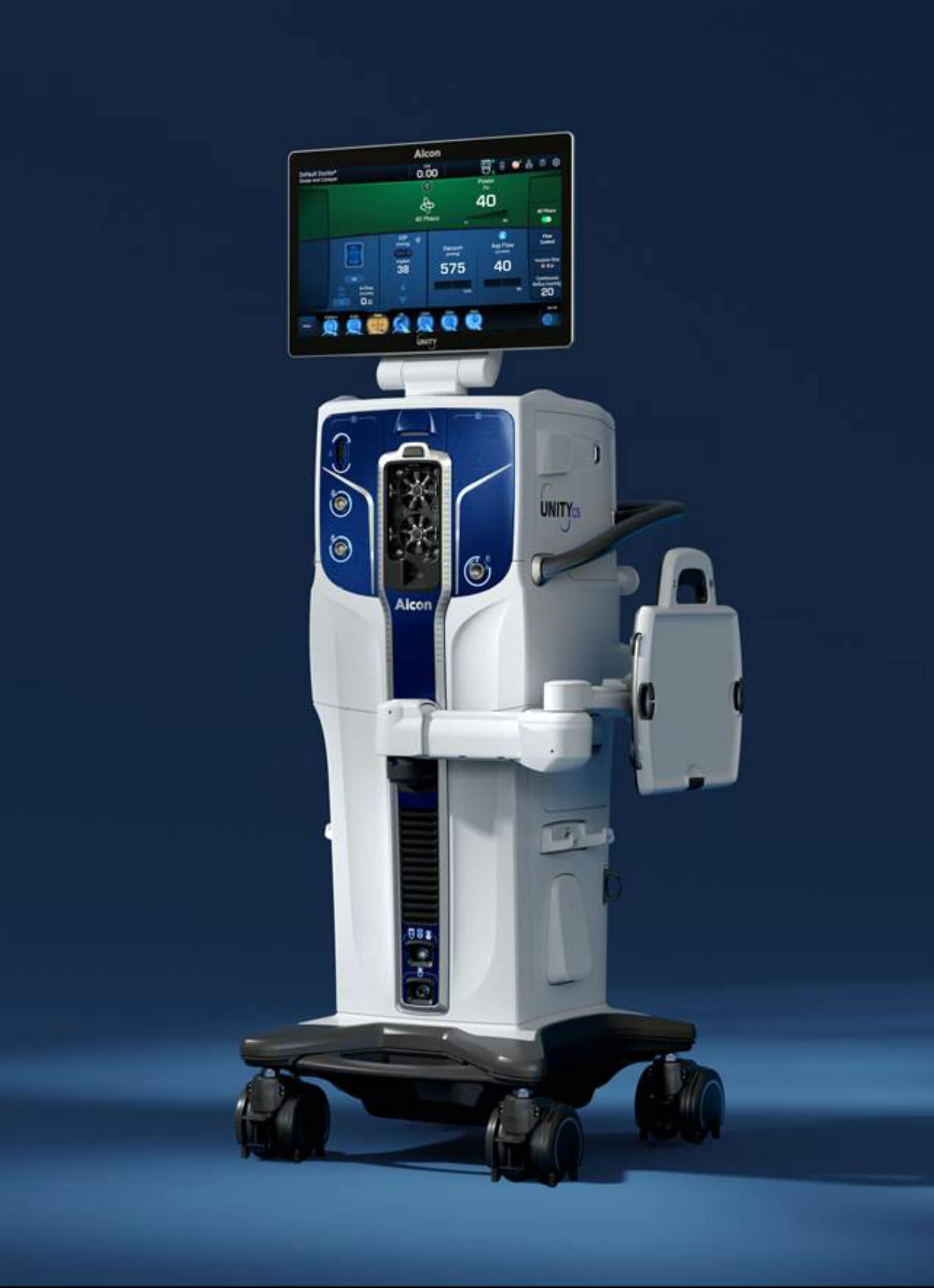
UNITY CS.
UNITY CS has been developed around Superior Efficiency.##, 2-5 The concept is broader than speed alone: it brings together technologies designed to address ultrasound energy delivery,11 fluidics,12 chamber stability,13-16 surgeon control17 and workflow across the cataract procedure.
One example is UNITY 4D Phaco. In bench testing, it delivered nucleus removal twice as fast as OZil§§, with 41% less energy delivered to the eye.# 3 Intelligent Fluidics provides pressure and flow control designed to support surgical stability and efficiency17, while Intelligent Sentry is designed for active anterior-chamber surge mitigation.18.
“Efficiency in cataract surgery is not one number on a specification sheet,” Duran says. “A surgeon can remove a nucleus quickly, but the experience of the procedure also depends on fluidics, chamber stability, control and how the system behaves from one step to the next. The engineering challenge is to make those elements work together, because that is closer to how a surgeon and theatre team actually experience a system.”
That broader view of efficiency comes into sharper focus across a busy cataract list, where the interaction between different elements of a system can matter as much as the performance of any individual feature. It also reflects a wider direction in surgical innovation: designing technologies not only for individual performance, but for how they work together in real clinical settings.
Technology, of course, is only one part of the equation. Clinical judgement remains central, while questions of access, procurement, capacity and pathway design depend on the wider health system in which new technology is introduced. What technology can do is address specific needs within that environment - and make a case for adoption where the difference is meaningful and practical.
One operation, two innovation questions
An advanced IOL and a cataract system might appear to tell two separate technology stories. Viewed across the cataract pathway, however, they show the same principle applied to different needs: identify where there is meaningful room to improve, and then use optical design, engineering or workflow innovation to address it in a predictable way.
Before surgery: what does this patient need from their vision, and which option is clinically appropriate?
During surgery: what do the surgeon and theatre team need from the technology to perform the procedure with control and an efficient workflow?
The answers are not dependent on one another. Choosing a particular IOL does not dictate a particular surgical system, and equipment choice does not determine the lens. But both decisions contribute to the same broader ambition: giving surgeons technologies designed around the different needs in front of them.
That is perhaps the more interesting story of innovation in a mature, high-volume field. Progress does not always arrive as dramatic reinvention. Sometimes it means pushing an established category further - as with PanOptix Pro's approach to light utilisation and scatter. Elsewhere, it means rethinking how multiple elements of a procedure work together for superior efficiency experience##, 2-5 - as with UNITY CS and its focus on fluidics, stability and workflow.
For patients, surgeons and surgical teams, the real test is ultimately less whether an innovation is new than whether it makes a meaningful difference at the point in the pathway where it is needed.
*Simulated photopic through-focus point spread function (light intensity [energy])—polychromatic.
**Compared to Clareon PanOptix.
§PanOptix has 88% light utilization (12% scatter light)/PanOptix Pro 94% light utilization (6% scatter light).
§§Trademarks are the property of their respective owners.
#Based on N=10 HPs, Artificial cataract lens IOP 55mmhg vacuum of 450 mmHg
##Compared to CENTURION and CONSTELLATION Vision Systems. Based on bench testing.
References:
1. The Royal College of Ophthalmologists. Latest audit figures show improved outcomes of cataract procedures. National Ophthalmology Database cataract audit update. Available at: https://www.rcophth.ac.uk/latest-audit-figures-show-improved-outcomes-of-cataract-procedures/
2. Alcon data on file 2024. REF-24615.
3. Alcon data on file 2024. REF-24379.
4. Alcon data on file 2024. REF-24576.
5. Alcon data on file 2024. REF-24644.
6. Alcon data on file, 2025. REF-25218.
7. Alcon data on file, 2015. REF-08546.
8. Alcon data on file, 2025; REF-28331.
9. Alcon data on file, 2025; REF-28335.
10. Alcon data on file, 2025; REF-28336.
11. Bu JJ, Chung J, Afshari NA (2022) Efficient use of ultrasound in cataract surgery. Curr Opin Ophthalmol 33 (1): 41-46.
12. Ting DSJ, Rees J, Ng JY, Allen D, Steel DHW (2017) Effect of high-vacuum setting on phacoemulsification efficiency. J Cataract Refract Surg 43 (9): 1135-1139.
13. Alcon Data on File. 2024. REF-25562.
14. Suzuki H, Igarashi T, Takahashi H. Effect of a new phacoemulsification and aspiration handpiece on anterior chamber stability. J Cataract Refract Surg. 2023;49(1):91-96.
15. Vasavada V, Agrawal D, Vasavada SA, Vasavada AR, Yagnik J. Intraoperative performance and early postoperative outcomes following phacoemulsification with three fluidic systems: A randomized trial. J Refract Surg. 2024;40(5):e304-e312.
16. Nicoli CM, Dimalanta R, Miller KM. Experimental anterior chamber maintenance in active versus passive phacoemulsification fluidics systems. J Cataract Refract Surg. 2016;42(1);157-162.
17. Alcon Data on File 2024. REF-24899.
18. Unity Phaco Handpiece. Directions for Use.
Alcon medical device(s) comply with the current legislation for the medical devices. Please refer to relevant product’s instructions for use for complete list of indications, contraindications, warnings and serious incidents. Please find at: https://ifu.alcon.com/
© 2026 Alcon Inc. 10/2026


